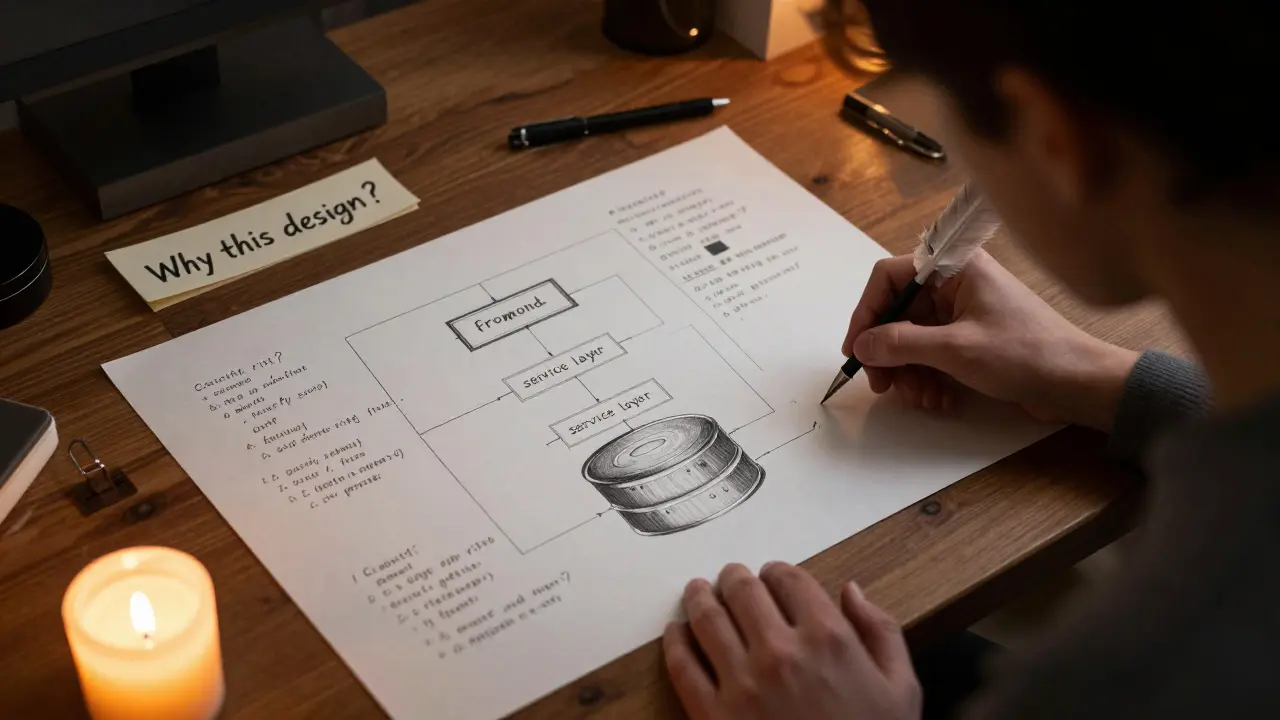
What if you could learn how to build complex software systems without writing a single line of code-at first? That’s the core idea behind vibe coding: a new way to teach software architecture by having students study, question, and analyze AI-generated code before they ever try to write it themselves. This isn’t about replacing programming-it’s about flipping the script. Instead of starting with syntax, loops, and variables, students begin by examining real, working applications built by AI and asking: Why did it do that? How is this organized? What’s the trade-off here?
Why Architecture Comes First
Traditional coding classes teach you how to write a for-loop before you even know what a REST API is. By the time you get to architecture-usually in your third or fourth semester-you’re already buried in bugs, messy code, and half-finished projects. A 2024 IEEE study found that students using conventional methods had 27.3% more technical debt in their final projects than those using vibe coding. Why? Because they never learned how to think about structure until it was too late. Vibe coding flips that. Students start with a fully functional web app generated by AI. Maybe it’s a todo list with user auth, or a small e-commerce backend. The instructor doesn’t explain how it works. Instead, they ask: What do you notice? Where’s the data stored? How does the frontend talk to the backend? Students don’t just read the code-they inspect it like detectives. They trace data flow. They map dependencies. They look for patterns: MVC, microservices, event-driven logic. This approach isn’t theoretical. Google’s AI Studio and Vibecode both offer tools that highlight architectural components directly in the code. Click on a function, and it shows you: “This is a service layer. It talks to a database via ORM. It’s designed for scalability.” No lecture. No slides. Just clear, interactive labels.The Vibe Coding Framework: How It Works
The method isn’t random. It follows the Vibe Programming Framework, a structured system developed by educators and AI engineers in 2024. It’s built on five core principles:- Augmentation Not Replacement - AI writes code, but humans decide if it’s right.
- Verification Before Trust - You can’t modify code until you can explain why each part exists.
- Maintainability First - Clean, readable structure matters more than clever hacks.
- Security by Design - Students must identify potential vulnerabilities before deployment.
- Knowledge Preservation - Every architectural decision must be documented in the student’s own words.
- AI generates a full-stack app based on a simple prompt: “Build a weather app with location lookup and 5-day forecast.”
- Students open the code in a sandbox environment (like Replit or Vibecode) and are given 45 minutes to explore.
- They answer guided questions: “Where is the API key stored? Is it secure? What happens if the network fails?”
- They must write a short explanation: “The frontend uses localStorage to cache location data to reduce API calls. This improves performance but risks data loss if the browser is cleared.”
- Only after passing a verification quiz (95% accuracy required) can they make changes.
How It Compares to Traditional Methods
Most universities still teach programming the old way: syntax first, then data structures, then design patterns-years later. A Stanford study from January 2024 found that 63% of students couldn’t connect their code to real architectural patterns until their final year. Pair programming helped, but only after students had already built bad habits. Vibe coding changes that. In Google’s internal pilot, beginners built a fully architected web app with proper separation of concerns in 3 hours. Using traditional methods? 14 hours. The University of Washington found students using vibe coding understood architectural patterns 42% faster. But there’s a catch: they spent 18% more time inspecting code before writing any of their own. That’s the trade-off. You trade speed of initial output for depth of understanding. And it pays off. A 2024 ACM survey of 1,200 students showed that 82% felt confident discussing system design after just two weeks of vibe coding-compared to 28% in traditional classes. But it’s not perfect. The IEEE SIGCSE warned in May 2024 that 57% of students initially became “prompt-dependent”-they’d just keep asking AI for new versions instead of learning why the first one worked. Without strict inspection protocols, students retained only 32% of architectural concepts. With them? 78%.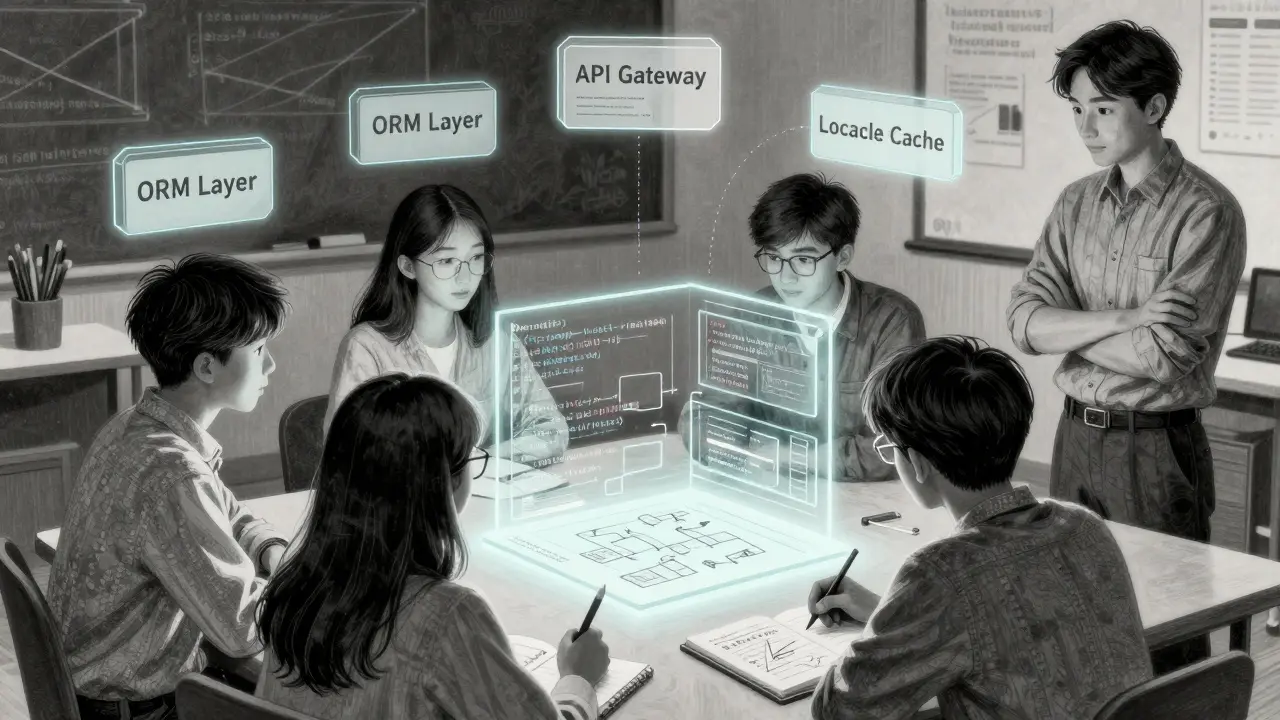
Real-World Impact
This isn’t just a classroom experiment. Industry is already using it. Amazon’s entire new developer onboarding program now uses vibe coding to teach architecture. LinkedIn reported a 210% jump in job postings asking for “experience with AI-assisted development and code inspection” in 2024. Companies aren’t looking for coders who can type fast. They’re looking for engineers who can evaluate, adapt, and improve systems. Maria Rodriguez, a former retail worker in Ohio, went from zero coding experience to building a fully architected e-commerce app in eight weeks using vibe coding. She didn’t learn Python first. She learned how to read architecture. Then she learned to write. Today, she’s working as a junior frontend engineer at a startup. Meanwhile, a community college in Ohio shut down their vibe coding pilot after 61% of students couldn’t explain basic architectural decisions without AI help. Why? Because they skipped the inspection phase. The tools were there. The structure wasn’t enforced.What You Need to Get Started
If you’re an educator or a self-learner, here’s what you actually need:- A platform: Google AI Studio (free for educators), Replit Edu ($15/student/year), or Vibecode for Education ($20/student/year).
- A structured curriculum: Use the Vibe Framework’s five principles as your guide. Don’t wing it.
- Verification checkpoints: Require written explanations before allowing code changes. No exceptions.
- Inspection rubrics: Create simple checklists: “Did they identify the data layer? Did they explain caching? Did they note security risks?”

The Future of Coding Education
Gartner predicts that by 2026, 80% of intro CS courses will use some form of AI code inspection. Google’s new “Architecture Lens” feature-set to roll out in early 2026-will automatically tag architectural patterns in generated code and explain trade-offs in real time. Microsoft and Vibecode are integrating these workflows into GitHub Classroom. The goal isn’t to remove human coding. It’s to remove the delay between learning syntax and understanding systems. The big question isn’t whether vibe coding will replace traditional methods. It’s whether we’re ready to let students think like engineers before they learn to type.By 2027, experts expect this to become the standard. Traditional syntax-first teaching will be saved for specialized courses-like embedded systems or kernel programming-where low-level control matters more than abstraction.
What You Should Do Now
If you’re teaching coding:- Start one lesson with AI-generated code. Don’t explain it. Just ask: “What do you see?”
- Require students to write one paragraph explaining the architecture before they touch the code.
- Use Replit or Google AI Studio-both have free tiers for education.
- Find an AI-generated app (GitHub has thousands). Don’t run it. Open the code.
- Ask: “Where’s the logic? Where’s the data? How are they connected?”
- Try to redraw the architecture on paper. Then compare it to what you think the AI intended.
Is vibe coding just about using AI to write code for you?
No. Vibe coding is the opposite. It uses AI to generate code so students can learn to inspect, question, and improve it-not just accept it. The goal isn’t to avoid writing code; it’s to understand architecture before you write a single line.
Can vibe coding teach low-level programming like C or assembly?
Not well. Vibe coding excels at teaching high-level architecture-web apps, APIs, microservices, cloud systems. But it struggles with low-level concepts like memory management, register allocation, or hardware interaction. Those still require traditional, hands-on learning. Vibe coding complements, not replaces, foundational programming.
Do students become dependent on AI and lose critical thinking?
Yes-if you skip the inspection phase. Studies show that without structured verification (like mandatory explanations and quizzes), 57% of students develop prompt dependency. But when the Vibe Framework’s protocols are followed, students don’t rely on AI-they learn to evaluate it. The key is making them justify every change.
Is vibe coding only for university students?
No. Coding bootcamps (67% of which now use some form of it) and even K-12 programs are adopting it. Vibecode’s education platform targets high schoolers, and Google’s AI Studio has free tools for middle and high school classrooms. The method works for any learner who can read and reason-not just college students.
What’s the biggest challenge in implementing vibe coding?
The biggest hurdle is changing how instructors teach. Instead of lecturing about architecture, you become a facilitator of code inspection. Many teachers need 6-8 weeks to retrain. Platforms help, but the mindset shift is the hardest part. You’re no longer the expert who gives answers-you’re the guide who asks the right questions.


