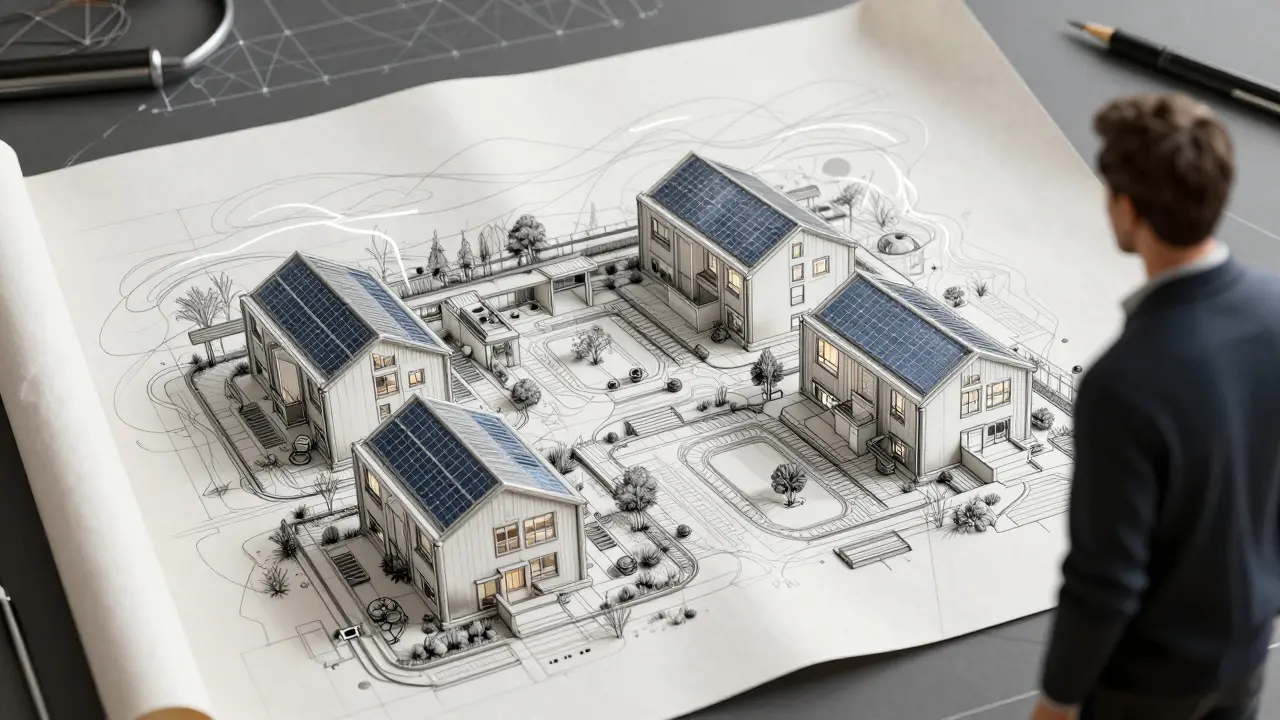
When you start a building project or design a software system, you don’t just pick a style or a framework and go. You make decisions-hundreds of them. Where do the windows go? Should the server be monolithic or microservices? What materials will last 50 years? Who pays for the maintenance? These aren’t just technical choices. They’re architectural decisions. And now, AI isn’t just helping with drafting or code autocomplete-it’s reshaping how those decisions get made.
AI Isn’t Replacing Architects-It’s Giving Them Superpowers
Think of AI in architecture like a co-pilot with a PhD in every building code, climate model, and material science paper ever written. It doesn’t decide for you. But it shows you options you’d never have considered. Take the Phoenix housing project. Human designers wanted affordable, sustainable homes. The AI looked at sunlight angles, wind patterns, material costs, and local labor availability. Then it suggested a layout with oddly shaped courtyards that increased natural light by 40% and cut construction time by 80%. The result? Carbon-negative facades, modular units assembled in two weeks, and a design that passed every code without a single revision.
This isn’t science fiction. It’s happening now. Around 70% of architecture firms are either using AI tools or planning to within the next year. Why? Because AI doesn’t get tired. It doesn’t miss a zoning law buried in a 300-page PDF. It runs 500 variations of a floor plan in six hours. And it learns from your past choices. If you always prefer taller ceilings in residential units, it starts suggesting that before you even ask.
Generative Design: From Sketches to Solutions in Minutes
Remember when architects spent weeks hand-drawing floor plans? Now, you input a few constraints: building size, budget, number of units, local climate, and energy targets. Then you hit generate. AI doesn’t just draw shapes-it creates functional spaces optimized for human behavior. A hospital wing? It places nurse stations where foot traffic peaks. A school? It clusters classrooms by noise levels and natural light. A commercial tower? It rotates the building to maximize solar gain while minimizing glare.
Tools like Forma and ARK let you slide sliders to change room percentages, and instantly see the impact on cost, carbon footprint, and daylight hours. One firm using Forma cut design iteration time from two weeks to six hours. That’s not efficiency-that’s a revolution. And it’s not just for big firms. Smaller practices now have access to the same computational power that once cost millions.
Parametric Architecture: When the Rules Are Code, Not Blueprints
Traditional design is about fixed shapes. Parametric design is about rules. Instead of drawing a window, you define: "All windows must receive at least 4 hours of direct sun between 9 AM and 3 PM, be no more than 1.2 meters from the floor, and not obstruct emergency exits." AI then generates every possible configuration that satisfies those rules.
This approach lets architects explore shapes that look alien but perform perfectly. A curved facade isn’t just for looks-it’s engineered to deflect wind, reduce heat gain, and channel rainwater into a reuse system. The AI doesn’t care if it looks strange. It only cares if it meets the parameters. And that’s where human judgment comes in. You pick the best version. Not because it’s pretty. Because it’s smart.
BIM + AI: The Living Blueprint
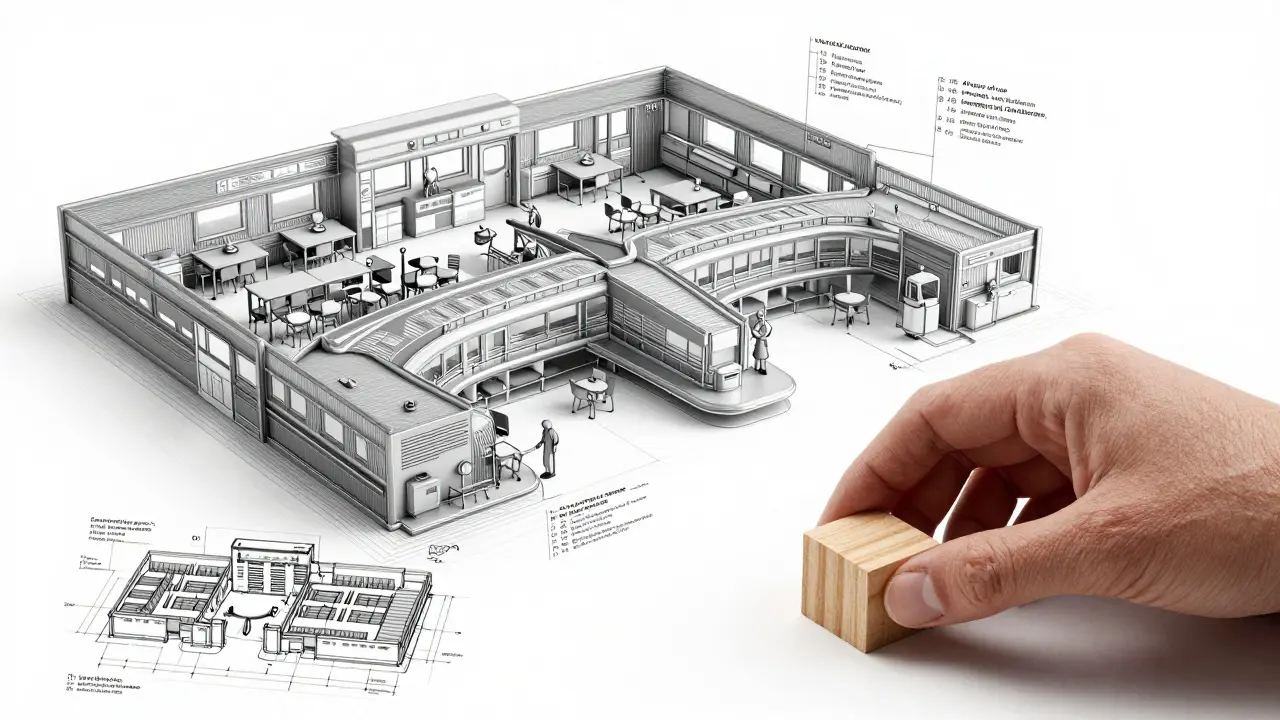
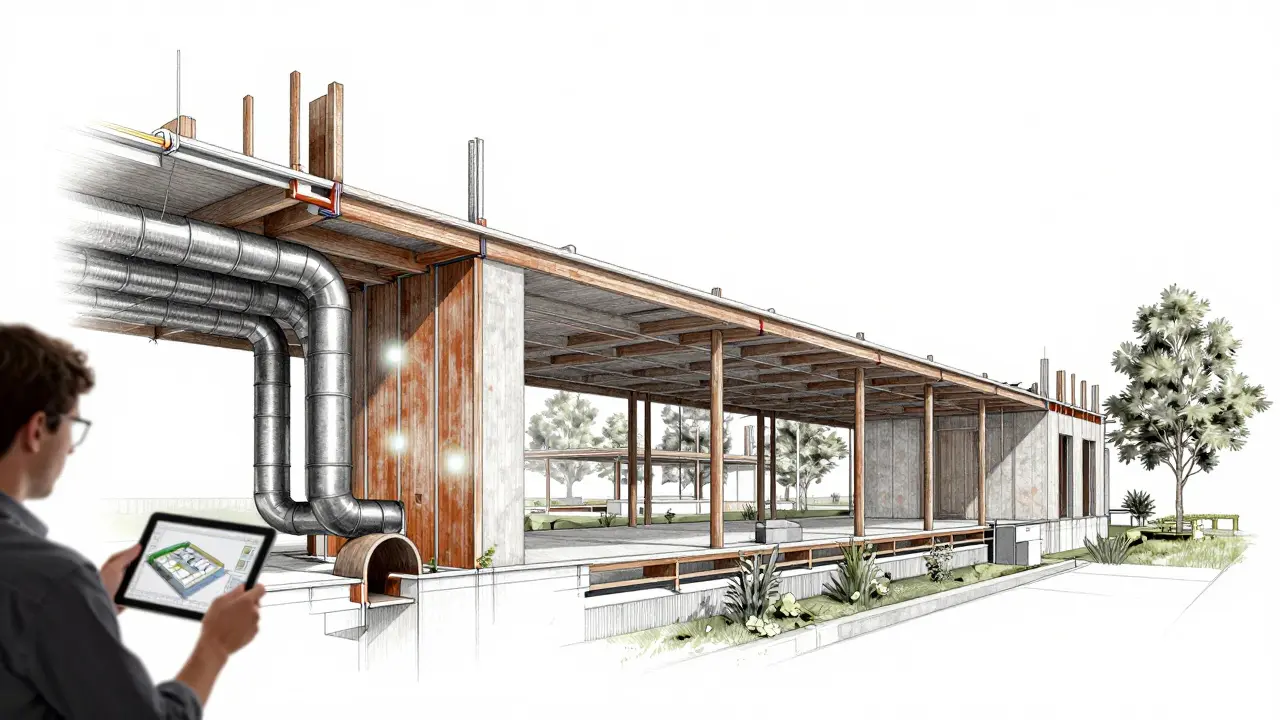
Building Information Modeling (BIM) isn’t just 3D drawings anymore. It’s a live database of every screw, pipe, and circuit in a building. When you add AI to BIM, it becomes a predictive assistant. It doesn’t wait for a clash between ductwork and rebar to show up on-site. It spots it before the foundation is poured.
AI also handles maintenance. It knows which HVAC unit is likely to fail next month based on usage patterns, ambient temperature, and past repair logs. It schedules replacements before anyone notices a problem. It updates the BIM model in real time as changes happen-no more outdated PDFs floating around the site office.
One project in Albuquerque used AI-integrated BIM to reduce rework by 62%. Why? Because the system flagged a conflict between plumbing and structural beams in the 3D model before construction started. Without AI, that mistake would’ve cost $280,000 to fix after the walls went up.
Sustainability Isn’t a Bonus-It’s the Default
Green building used to mean adding solar panels and calling it a day. Now, AI optimizes sustainability from day one. It doesn’t just calculate energy use-it simulates real-world conditions. Wind speed. Noise pollution. Solar path. Thermal mass. Even the impact of nearby trees.
AFRY used AI to test how a new office building would perform in winter winds. The original design had a glass atrium. The AI showed it would create cold drafts in the lobby. So they moved the atrium, added a thermal buffer zone, and reduced heating costs by 37%. No one would’ve caught that without simulation.
AI also handles embodied carbon-the emissions from materials before the building even opens. It compares concrete, steel, timber, and recycled composites. It finds the option with the lowest footprint that still meets structural codes. In one case, switching from steel to cross-laminated timber cut emissions by 58% and saved $1.2 million.
Software Architecture Gets an AI Co-Pilot Too
It’s not just buildings. Software architecture is changing too. AI doesn’t write your code. But it spots antipatterns. It says: "Your microservices are talking to each other over HTTP with no circuit breaker. You’re going to crash under load." Or: "Your database schema has 17 foreign keys. That’s a maintenance nightmare. Normalize this."
Teams using AI-assisted architecture reviews catch 80% more design flaws before deployment. Tools like GitHub Copilot and Amazon CodeWhisperer now suggest not just lines of code, but architectural patterns. They recommend using event-driven systems instead of synchronous APIs. They flag monolithic dependencies that should be split. They suggest caching layers before performance becomes an issue.
And it works early. Instead of waiting for a system to fail in production, AI helps design it right from the start. Requirement gathering? AI analyzes past projects to predict which features will cause the most bugs. Architecture planning? It compares your design against 10,000 successful systems and flags deviations.
Human Judgment Still Wins-Every Time
AI is powerful. But it’s not wise. It doesn’t understand culture. It doesn’t know that a hospital’s waiting room should feel calming, not efficient. It doesn’t care that a school needs spaces for kids to scream and run. It doesn’t know your company’s tech debt policy or your client’s unspoken preference for brick over glass.
The best outcomes happen when AI handles the math, and humans handle the meaning. An architect must ask: "Is this design humane?" "Does it reflect our values?" "Will it age well?" AI can’t answer those. But it can give you the data to answer them.
Over-reliance on AI leads to sterile, soulless designs. Blind rejection wastes time. The sweet spot? Let AI explore 100 options. Let humans pick the one that feels right.
What’s Next? The Tools Are Here-Now We Need the Mindset
AI-assisted architectural decision-making isn’t a future trend. It’s here. And it’s changing how we build-both physically and digitally. The winners won’t be the ones with the fanciest AI. They’ll be the ones who understand its limits. Who use it to amplify creativity, not replace it. Who let it handle the repetitive, the complex, and the data-heavy-so they can focus on what matters: people.
Start small. Try one AI tool on one project. See what it uncovers. Then ask: "Did this make us better?" Not faster. Not cheaper. Better.
Can AI replace human architects in design decisions?
No. AI doesn’t replace architects-it enhances them. While AI can generate thousands of design options, optimize for sustainability, and detect code violations, it lacks human judgment, cultural context, and emotional intelligence. Architects must still evaluate AI suggestions against human needs, ethical considerations, and long-term usability. The most successful projects combine AI’s computational power with human creativity and empathy.
What are the most common AI tools used in architectural design today?
The most widely adopted tools include Forma for generative design and sustainability analysis, ARK for cost and resource optimization, and integrated BIM platforms like Autodesk Revit with AI plugins for clash detection and predictive maintenance. In software, tools like GitHub Copilot and Amazon CodeWhisperer assist with architectural pattern suggestions and antipattern detection. These tools are used by firms ranging from large multinational practices to small studios.
How does AI improve sustainability in building design?
AI analyzes environmental data-sun path, wind patterns, material emissions, and energy usage-to optimize building orientation, window placement, insulation, and HVAC systems. It can simulate real-world conditions to reduce energy consumption by up to 40% and lower embodied carbon by selecting low-emission materials. For example, AI helped the Phoenix housing project cut carbon emissions by using carbon-negative facades and modular construction, achieving LEED certification without manual trial-and-error.
What’s the difference between parametric design and traditional design?
Traditional design starts with a fixed shape or layout. Parametric design starts with rules-like "windows must receive 4 hours of sun" or "structural load must not exceed 12 tons per square meter." AI generates all possible configurations that meet those rules, often producing complex, non-intuitive shapes. This approach allows for highly optimized designs that would be impossible to calculate manually, while still ensuring structural integrity and code compliance.
Can AI help with software architecture decisions like microservices vs. monoliths?
Yes. AI tools can analyze codebases and architecture diagrams to detect signs of overcomplication, tight coupling, or scalability risks. For example, if a system has 15 services communicating via synchronous HTTP calls without retries or timeouts, AI can flag it as a failure point. It can suggest switching to event-driven patterns or adding circuit breakers. These insights help teams make better architectural choices before deployment, reducing downtime and technical debt.
What risks come with relying too much on AI in architectural decisions?
Relying too heavily on AI can lead to sterile, formulaic designs that ignore human experience. AI may optimize for cost or efficiency but miss cultural, emotional, or historical context. It can also inherit biases from training data-like favoring certain materials or layouts because they were common in past projects. Without human oversight, teams risk creating buildings or systems that are technically perfect but functionally alien. Always validate AI outputs against real-world needs and stakeholder values.


