
For years, AI could read text or see images-but never both at the same time, the way humans do. That’s changed. Today, vision-language models (VLMs) are the new baseline in AI. They don’t just process pictures and words separately. They understand how they connect. A photo of a broken machine, a handwritten repair note, and a manager’s voice command? All of it gets fused into one coherent understanding. This isn’t science fiction anymore. It’s what’s happening in warehouses, hospitals, and factories right now.
How Vision-Language Models Actually Work
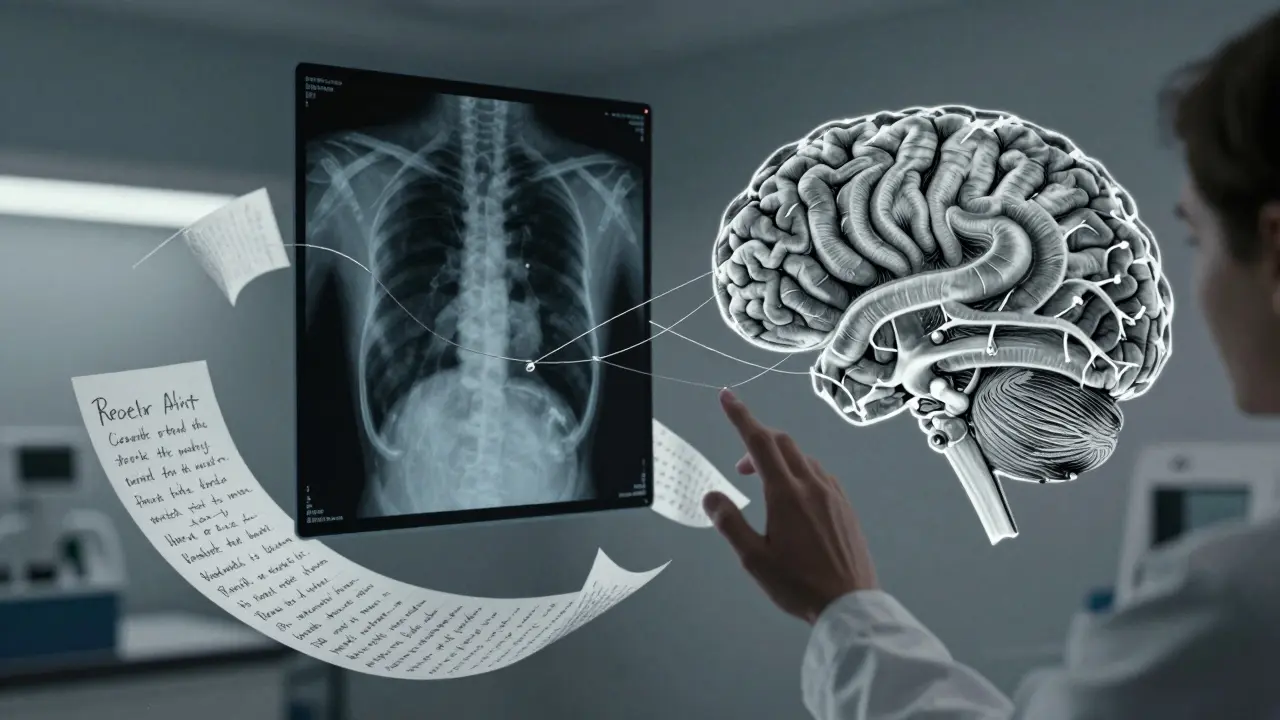
Early AI systems treated images and text like two different languages. You fed a photo into one model, typed a question into another, and hoped the results matched. Vision-language models throw that out. They use a single neural network trained on millions of image-text pairs. The model learns that a ‘red stop sign’ isn’t just a shape and a color-it’s a command. It learns that a medical X-ray with the text ‘suspected pneumonia’ means something specific, even if the handwriting is messy.
The magic happens in how visual data gets squeezed into the language model’s brain. Most models use a vision encoder-like ViT (Vision Transformer)-to turn pixels into a sequence of ‘visual tokens.’ These tokens are then mixed with text tokens inside the model’s attention layers. Think of it like a conversation between two experts: one who sees, one who reads. They don’t take turns. They talk over each other, refine each other’s thoughts, and arrive at a shared answer.
There are three main ways this is built:
- NVLM-D (Decoupled): Keeps vision and text processing separate until the final stage. Better for detailed document OCR-like reading handwritten invoices. But it’s slow and uses more power.
- NVLM-X (Cross-Attention): Merges visual and text data early. Much faster for high-res images-think satellite photos or product assembly lines. But it stumbles on fine print.
- NVLM-H (Hybrid): Combines both. The sweet spot for most real-world uses. Balances speed and accuracy.
GLM-4.6V, released in November 2024, uses the hybrid approach. It processes nearly 2,500 tokens per second on a single NVIDIA A100 GPU. That’s 20 times faster than older pipelines that used separate OCR and language models. And it keeps 97% OCR accuracy even when compressing images by 20 times.
Real-World Uses You Can See Today
These models aren’t just lab experiments. They’re already changing how businesses operate.
- Document Processing: Financial firms use VLMs to read loan applications, tax forms, and contracts-no matter the font, scan quality, or handwriting. GLM-4.6V outperforms older tools like MinerU2.0 on OmniDocBench, cutting manual review time by 60%.
- Healthcare Imaging: Radiologists in hospitals are using VLMs to flag abnormalities in X-rays and MRIs. When paired with patient notes, the model can suggest possible diagnoses faster than traditional systems. One study showed a 22% improvement in alignment with doctor interpretations when using instruction-tuned backbones like Qwen2-72B-Instruct.
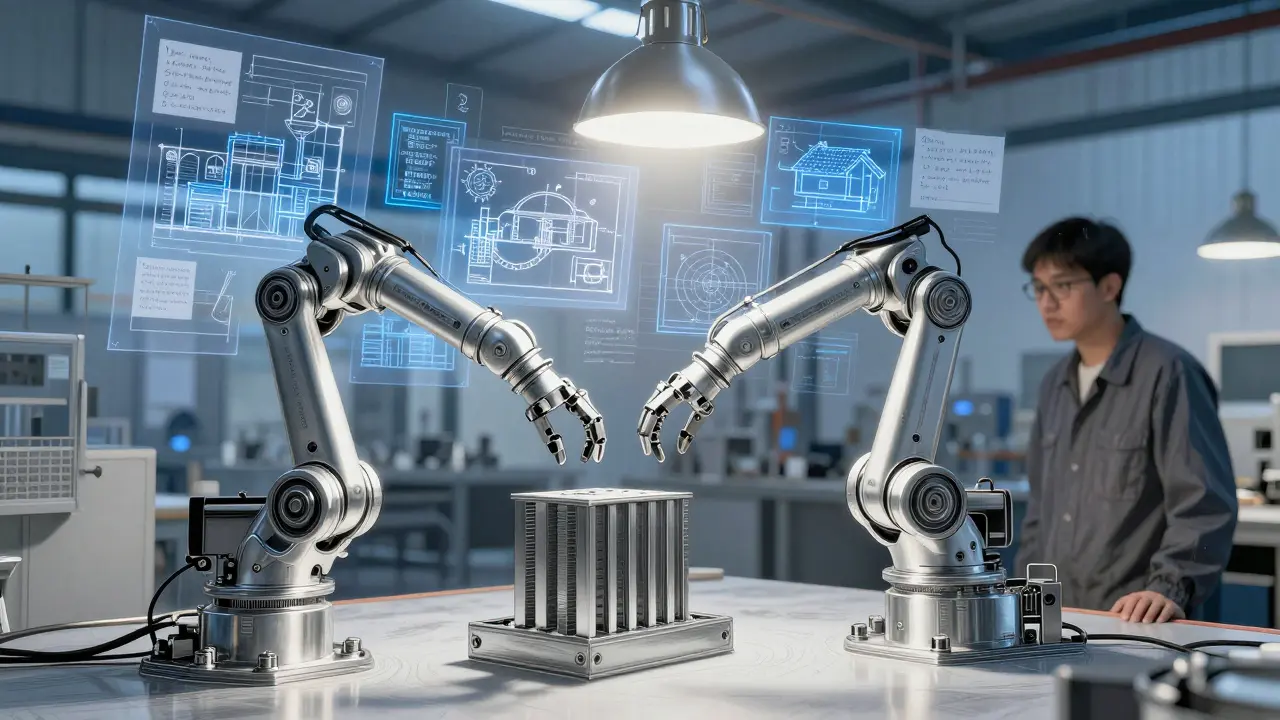
- Manufacturing Quality Control: On factory floors, cameras capture images of products. VLMs compare them to CAD diagrams and work instructions. If a screw is missing or a label is misaligned, the system flags it instantly. Companies like Siemens and Tesla are piloting this.
- Robotics: The Janus architecture is built for robots. It separates visual understanding from action planning. A robot sees a cup on a table, hears “hand me the cup,” and understands not just what the cup is, but how to reach for it. This cuts command errors by 37% in real tests.
Market data shows 42% of financial firms and 31% of healthcare orgs are already using VLMs for these tasks. Open-source models like GLM-4.6V and Qwen3-VL now make up 35% of new enterprise deployments in document processing.
What’s Holding These Models Back?
Despite the progress, there are hard limits.
Computational Cost: Training a 70B-parameter VLM uses 1,200 MWh of electricity-enough to power 110 homes for a year. Deploying one in production costs $12,000-$15,000 in GPU resources. That’s why small businesses still rely on older, cheaper tools.
Context Window Problems: GLM-4.6V supports 128K tokens. Sounds impressive. But a single high-res image can use 80% of that space before you even add text. Users on Reddit report running out of room trying to analyze multi-page contracts with embedded diagrams.
OCR Fails on Handwriting: While GLM-4.6V hits 97% accuracy on printed text, that drops to 82% on handwritten medical records. For digitizing patient files, that’s not good enough. One developer on GitHub called it “unusable” for healthcare.
Hallucinations: VLMs are more prone to making things up than text-only models. The MM-Vet benchmark shows hallucination rates 8-12% higher. A model might confidently say a photo shows a “red car” when it’s actually a blue truck. That’s dangerous in legal or medical settings.
Integration Pain: Most teams need 2+ years of computer vision experience and 1+ year with LLMs to deploy these systems. On average, it takes 14.3 weeks to go from idea to production. The biggest headaches? Image preprocessing (63% of issues) and managing context windows (41%).
Open Source vs. Proprietary: The New Battlefield
Two years ago, only OpenAI and Google had powerful VLMs. Now, open-source models are leading in key areas.
GLM-4.6V and Qwen3-VL aren’t just copying GPT-5 or Gemini-2.5-Pro. They’re beating them in specific tasks. GLM-4.6V uses 40% fewer vision tokens than Gemini-1.5-Pro on visual reasoning benchmarks. That means lower costs and faster responses.
But proprietary models still win in complex video understanding. On VideoMME benchmarks, open-source models lag by 12-15%. They’re not yet ready for real-time surveillance, autonomous driving, or live video analysis.
The trade-off is clear: Open-source models are cheaper, customizable, and transparent. Proprietary ones are more polished, reliable, and supported. For document processing? Go open-source. For consumer apps like photo search or smart assistants? Stick with the big players-for now.
What’s Coming Next?
Experts predict three big shifts by 2026:
- Specialization: 60% of new models will focus on one task-like medical imaging, legal document review, or factory inspection. General-purpose VLMs are fading.
- Efficiency: Vision token requirements will drop by 50% by 2025. That means running powerful models on cheaper hardware, like an RTX 4090 instead of an H100.
- Robotics Integration: 73% of researchers are prioritizing embodied AI. VLMs will be the brain inside robots that walk, grab, and interact with real environments.
Gartner predicts VLMs will be embedded in 85% of enterprise AI systems requiring visual understanding by 2027. That’s not a guess-it’s a roadmap. Companies that wait will be left behind.
How to Get Started
If you’re considering building with VLMs:
- Start with GLM-4.6V: It’s open, fast, and well-documented. GitHub has 4,287 stars and 321 contributors. Issues get fixed in under 4 days on average.
- Preprocess your images: Resize, normalize, and crop before feeding them in. This cuts context usage by 40% and boosts accuracy.
- Use vision token compression: 68% of successful deployments use this. It shrinks image data without losing key details.
- Don’t skip fine-tuning: Use instruction-tuned backbones like Qwen2-72B-Instruct. They align 22% better with human intent.
- Test for hallucinations: Build a validation layer that flags low-confidence outputs. Human review is still needed for high-stakes decisions.
And remember: this isn’t about replacing humans. It’s about giving them superpowers. A nurse with a VLM can review 50 X-rays in 10 minutes instead of 2 hours. A warehouse worker can spot a defective part before it ships. That’s the real win.
What’s the difference between a vision-language model and a regular AI model?
A regular AI model processes only one type of data-either text or images. A vision-language model (VLM) combines both. It doesn’t just recognize a picture of a cat and separately read the text ‘cat.’ It understands that the image and the word are the same thing, and can answer questions like, ‘Why is the cat sitting on the table?’ by using visual context and language together.
Can I run a vision-language model on my laptop?
Not with top-performing models like GLM-4.6V or Qwen3-VL. They require 70+ billion parameters and need high-end GPUs like NVIDIA A100 or H100. However, smaller versions (like LLaVA-1.6 with 7B parameters) can run on an RTX 4090, but with slower speeds and lower accuracy. For real-time use, cloud access is still the standard.
Are vision-language models better than separate OCR + LLM pipelines?
Yes, in almost every real-world scenario. Older pipelines process images first (using OCR), then send text to a language model. This creates delays and loses context. VLMs process both together. For example, if a form has a signature in the corner and the text says ‘signed by John,’ a VLM knows they’re connected. A separate system might miss that. Users report 20x faster processing and 30% fewer errors.
Why do vision-language models hallucinate more than text-only ones?
Because they’re combining two noisy sources. An image might be blurry, and the text might be ambiguous. The model tries to fill in gaps using patterns it learned, not facts. If it sees a shadow that looks like a dog and hears ‘pet,’ it might say ‘the person is petting a dog’-even if it’s a coat rack. Text-only models don’t have this visual noise. That’s why hallucination rates are 8-12% higher in VLMs.
What’s the best open-source vision-language model right now?
As of early 2026, GLM-4.6V leads in document processing and speed, while Qwen3-VL is stronger in multilingual tasks. For robotics, Janus is unmatched. LLaVA-1.6 is the easiest to run on consumer hardware. The ‘best’ depends on your use case: speed? GLM-4.6V. Accuracy on forms? Qwen3-VL. Building robots? Janus.


