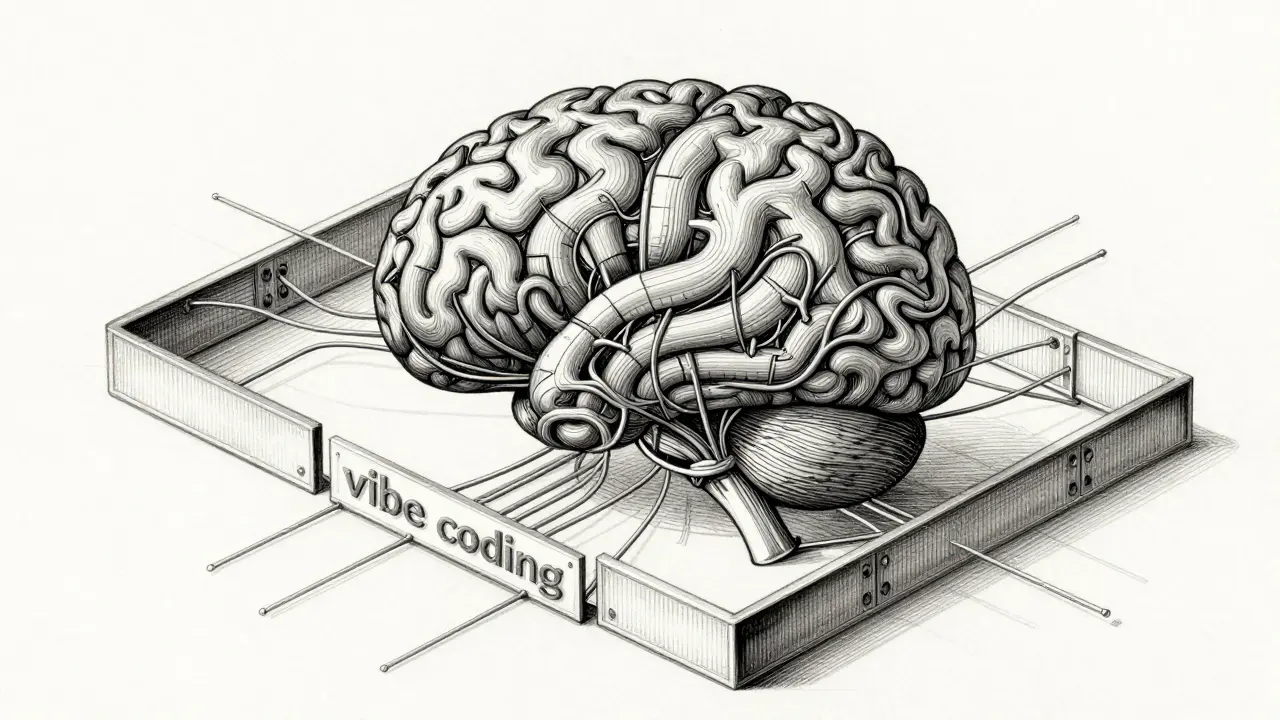
Imagine handing your codebase to an AI assistant. You give it a prompt, and within seconds, it writes a feature. Sounds like magic, right? Now imagine that same AI accidentally deleting your production database because it didn't understand the security rules of your specific stack. That’s the risk of vibe coding without guardrails.
Vibe coding-the practice of collaborating with large language models (LLMs) through natural language prompts-is exploding in popularity. But as teams move from solo experiments to enterprise deployment, a new problem emerges: chaos. Without structure, AI assistants hallucinate, introduce vulnerabilities, and create tech debt that humans have to clean up. The solution isn’t to stop using AI; it’s to govern how it works. Enter template repositories with pre-approved dependencies.
The Governance Gap in AI-Assisted Development
Most developers think of governance as boring paperwork. In the world of vibe coding, governance is actually about control. When you use an AI coding assistant like Cursor or Claude Code, you are effectively outsourcing implementation decisions to a probabilistic model. If that model doesn’t know your constraints, it will ignore them.
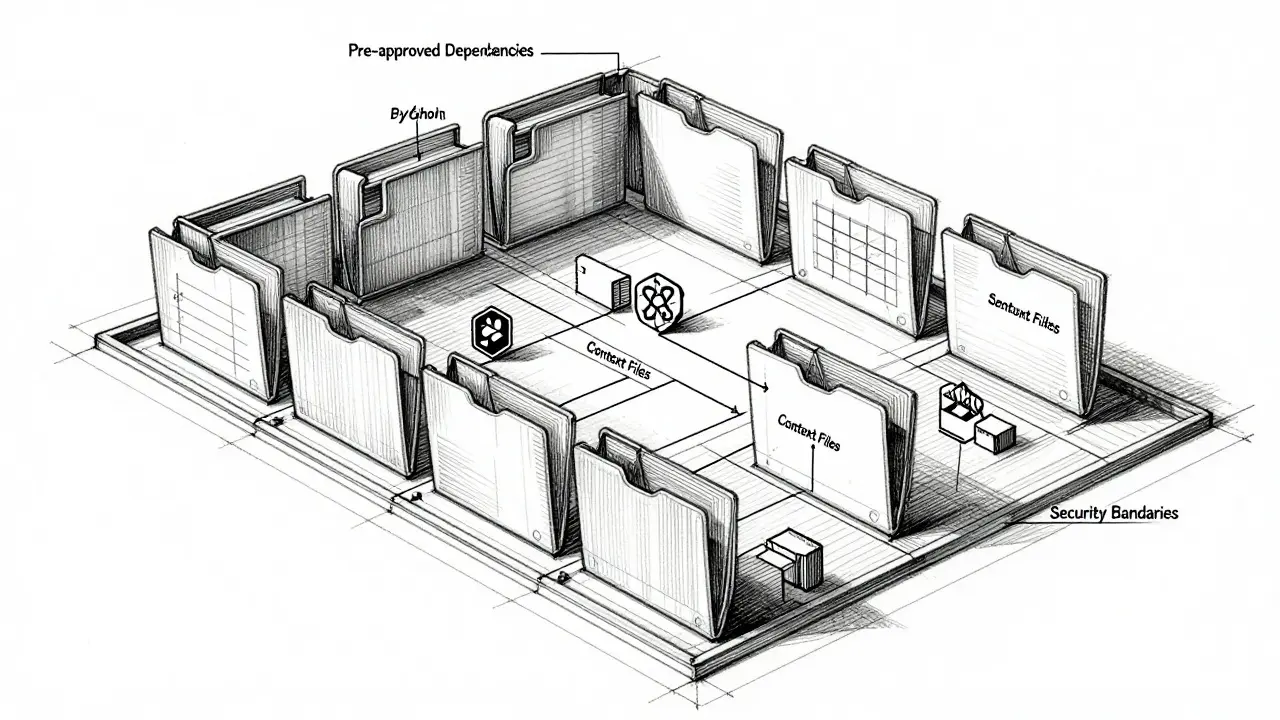
Template repositories solve this by providing a "golden path." These aren’t just empty folders. They are fully configured starter kits that include:
- Pre-approved dependencies: Libraries and frameworks that have already been vetted for security and compatibility.
- Context files: Specialized markdown files (like
CLAUDE.mdorCURSOR_RULES.md) that tell the AI exactly how your project is structured. - Security boundaries: Sandboxed environments that prevent the AI from accessing sensitive secrets or executing dangerous commands.
According to Ryan Carson, founder of Treehouse, properly engineered context files can reduce AI hallucinations by 73%. That’s not a minor improvement; it’s the difference between a tool that helps you and one that hinders you. For organizations, this means they can allow developers to use powerful AI tools without fearing that every line of code needs a manual audit before merging.
How Context Engineering Works Under the Hood
To understand why these templates matter, you need to understand context engineering. An LLM doesn’t “know” your project. It only knows what you show it in the current conversation window. If you start a fresh chat, the AI is blank slate. Every time you ask it to write a React component, it has to guess your styling preferences, your state management library, and your error handling patterns.
Template repositories bake this knowledge into the file system. Take the popular humanstack/vibe-coding-template. This repository includes a .cursor/rules directory. Inside, you’ll find rules that automatically apply when you edit specific files. For example, if you’re editing a Python FastAPI backend, the AI knows to follow PEP 8 standards and use Pydantic for validation. If you’re editing a Next.js frontend, it knows to use Tailwind CSS and server components.
This eliminates the need for repetitive prompting. Instead of saying, “Remember, we use Supabase for auth,” you just point the AI at the CONTEXT.md file. The AI reads the file once and applies those rules throughout the session. This consistency is crucial for team collaboration. When five developers use the same template, they get five consistent outputs, not five different styles.
Key Players in the Vibe Coding Template Space
Not all templates are created equal. Some focus on speed, others on security, and some on specific stacks. Here’s a breakdown of the leading options as of early 2024, which set the stage for today’s landscape:
| Repository | Primary Focus | Key Tech Stack | Governance Feature |
|---|---|---|---|
| humanstack/vibe-coding-template | Full-stack production apps | Next.js, FastAPI, Supabase | Cursor Rules, automated setup scripts |
| superagent-ai/vibekit | Enterprise security & compliance | Docker sandboxes, LiteLLM | Secret redaction, offline operation, GDPR ready |
| coleam00/context-engineering-intro | Education & best practices | Markdown-based context files | Teaches CLAUDE.md structure and PRP blueprints |
| feiskyer/claude-code-settings | Multi-LLM routing | Claude Code, LiteLLM proxy | Vendor lock-in prevention, custom commands |
The humanstack template is great for startups moving fast. It handles the heavy lifting of setting up Docker, Node.js, and Python environments. However, it requires significant initial setup. On the other hand, VibeKit by Superagent AI is built for companies that care about security. It runs AI agents inside Docker containers, ensuring that even if the AI tries to access a secret key, it can’t escape the sandbox. This is critical for industries like healthcare or finance, where data privacy laws are strict.
Implementing Pre-Approved Dependencies
The phrase “pre-approved dependencies” might sound bureaucratic, but it’s a practical necessity. In traditional development, you choose libraries based on their features. In vibe coding, you also need to choose them based on how well the AI understands them.
If you use an obscure library that the LLM hasn’t seen much in its training data, the AI will struggle to generate correct code. It will make more mistakes, and you’ll spend more time debugging. By restricting your team to a curated list of dependencies-like React, FastAPI, and Supabase-you ensure that the AI has high confidence in its outputs.
Here’s how to implement this in your own workflow:
- Audit your stack: Identify the core libraries your team uses most often.
- Create a base template: Build a repository that includes these libraries with standard configurations.
- Document the rules: Write a
CLAUDE.mdor equivalent file that explains how to use these libraries. Include examples of good and bad code. - Lock versions: Use lockfiles (
package-lock.json,requirements.txt) to ensure everyone, including the AI, uses the same versions.
This approach reduces cognitive load. Developers don’t have to decide which library to use for each task. They just pick the one that’s already there. The AI does the same thing. This alignment leads to faster development cycles and fewer integration errors.

Security Risks and Mitigation Strategies
Let’s talk about the elephant in the room: security. AI-generated code can be vulnerable. GitHub’s security team reported 12 critical vulnerabilities in AI-generated code from template repositories in late 2023. These weren’t subtle bugs; they were things like hardcoded API keys and SQL injection flaws.
So, how do you stay safe while using vibe coding templates?
- Sandboxing: Never let an AI agent run directly on your main machine. Use Docker containers or virtual machines. Tools like VibeKit make this easy by default.
- Secret Redaction: Ensure your environment variables are never exposed to the AI. Most modern templates include scripts that mask secrets before sending context to the LLM.
- Code Review: Don’t trust the AI blindly. Always review generated code, especially for security-sensitive functions like authentication and payment processing.
- Dependency Scanning: Use tools like Snyk or Dependabot to scan for vulnerabilities in the pre-approved dependencies themselves.
Maria Chen, a software architect, warned that over-reliance on templates can create junior developers who can’t troubleshoot when the AI fails. To counter this, encourage your team to understand the underlying code. Use the template as a starting point, not a black box. Teach developers how to read and modify the context files so they can adapt them to new situations.
The Future of Vibe Coding Governance
We are still in the early days. As of 2024, only 17% of Fortune 500 companies allowed vibe coding templates in production. But that number is growing. Analysts predict that by 2025, most specialized templates will be absorbed into major IDEs like VS Code and Cursor. This means governance will become a native feature of your development environment, not something you have to manually configure.
For now, the best strategy is to build your own internal templates. Start small. Pick one project, define your rules, and test how well the AI follows them. Iterate based on feedback. Over time, you’ll develop a library of templates that reflect your company’s unique standards and security requirements.
Vibe coding isn’t going away. It’s here to stay. The question isn’t whether to use it, but how to use it responsibly. With the right templates and governance practices, you can harness the power of AI without sacrificing quality or security.
What is vibe coding?
Vibe coding is an emerging paradigm in AI-assisted software development where developers collaborate with large language models (LLMs) through carefully engineered context and templates. Instead of writing every line of code manually, developers guide the AI with natural language prompts, relying on structured context files to ensure consistent and high-quality output.
Why are pre-approved dependencies important in vibe coding?
Pre-approved dependencies ensure that the AI assistant is working with libraries and frameworks it understands well. This reduces hallucinations and errors. Additionally, it allows organizations to maintain security and compliance standards by limiting the codebase to vetted technologies.
How do context files like CLAUDE.md work?
Context files serve as persistent instructions for AI coding assistants. They contain project-specific rules, such as coding standards, architecture patterns, and library usage guidelines. When the AI reads these files, it applies the rules to all subsequent code generation, ensuring consistency across the project.
Is vibe coding secure for enterprise use?
It can be, but only with proper governance. Enterprises should use sandboxed environments (like Docker), implement secret redaction, and conduct rigorous code reviews. Templates like VibeKit are designed specifically for enterprise security, offering features like offline operation and compliance checks.
What are the best vibe coding templates available?
Popular options include humanstack/vibe-coding-template for full-stack apps, superagent-ai/vibekit for security-focused enterprises, and coleam00/context-engineering-intro for learning context engineering principles. The best choice depends on your specific tech stack and security requirements.
How long does it take to set up a vibe coding template?
Setup times vary by complexity. Simple templates may take 10-15 minutes, while comprehensive full-stack solutions like humanstack's can take around 22 minutes on average. Developers familiar with Docker and environment variables will find the process smoother.
Can I create my own vibe coding template?
Yes, absolutely. Start by identifying your core tech stack and security requirements. Create a base repository with pre-configured dependencies and write detailed context files (e.g., CLAUDE.md) that outline your coding standards. Test the template with an AI assistant and iterate based on the results.
What is context drift in vibe coding?
Context drift occurs when an AI assistant gradually ignores the instructions provided in context files after extended sessions. This can lead to inconsistent code quality. To mitigate this, keep context files concise and consider restarting the AI session periodically.