
Imagine you just deployed a shiny new Large Language Model (LLM) is an AI system capable of understanding and generating human language by processing vast amounts of text data to handle customer support tickets. It sounds like magic until the model starts quoting confidential internal memos or giving legally risky advice based on outdated training data. This isn't a hypothetical nightmare; it's the reality many enterprises face when they rush into AI without a solid foundation. The core problem isn't the technology itself-it's the lack of structure around the data that fuels it.
Traditional data governance frameworks were built for structured databases and clear rules. They simply don't scale in the age of AI. As noted by industry experts at dbt Labs, manual approaches are failing because there is too much data, from too many teams, changing too quickly. To deploy LLMs responsibly, organizations need a dynamic, continuous, and multidisciplinary approach. This article breaks down exactly how to build that framework, ensuring your AI initiatives drive value without exposing your company to regulatory penalties or reputational damage.
Why Traditional Governance Fails with LLMs
You might think your existing data policies are enough. They aren't. Traditional systems rely on deterministic logic-if input A happens, output B occurs. LLMs are different. They are probabilistic models that generate stochastic responses not directly correlated to specific inputs. This unpredictability creates unique governance concerns that didn't exist before.
Consider the volume of data involved. Approximately 80-90% of enterprise data is unstructured-emails, contracts, social media posts, and chat logs. Legacy tools struggle to catalog this mess. LLMs thrive on it. Without a way to track where this unstructured data comes from and how it’s used, you’re flying blind. If an LLM generates biased content, you need to know which dataset caused it. Without lineage tracking, you can’t fix the root cause, only patch the symptom.
The regulatory landscape is also shifting rapidly. With frameworks like the EU AI Act coming into force, regulators now view data quality and lineage as strict compliance requirements. High-risk AI systems must demonstrate transparency and human oversight. Ignoring these changes invites fines and operational shutdowns. Governance is no longer just IT housekeeping; it’s a legal imperative.
Core Principles of Effective LLM Governance
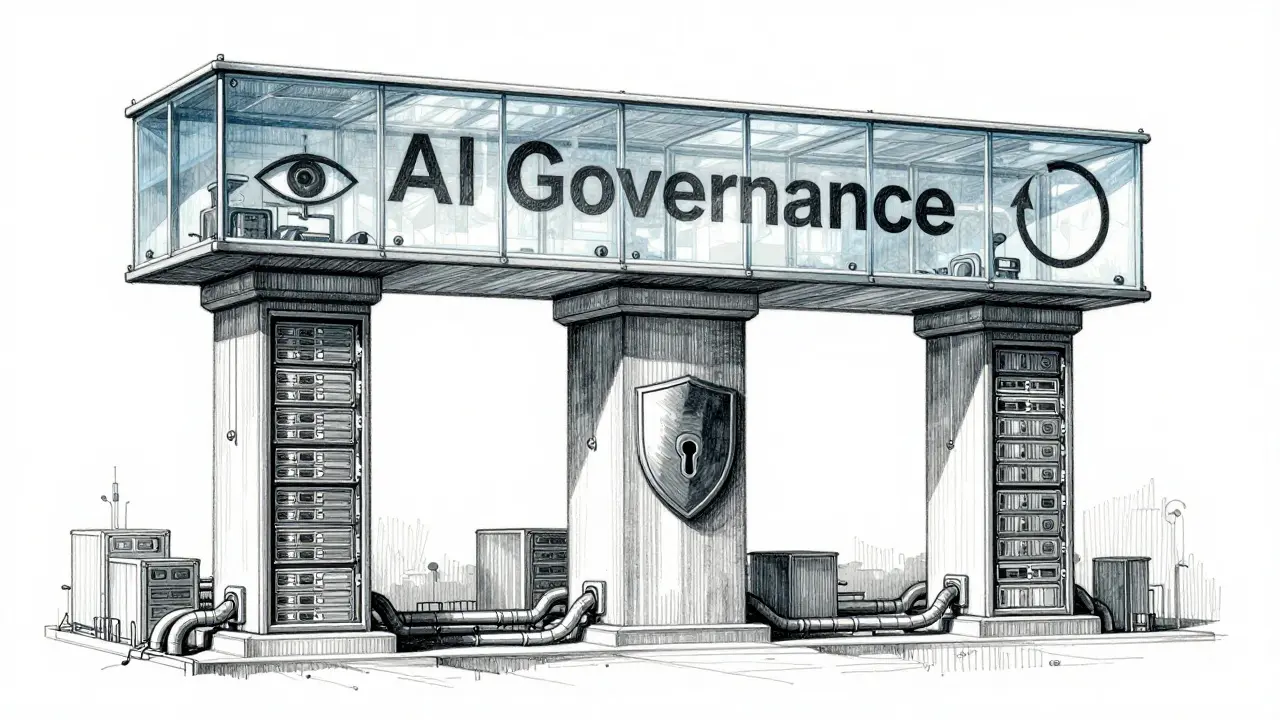
To navigate this complexity, focus on three non-negotiable pillars: transparency, data integrity, and continuous monitoring. These principles form the backbone of any successful strategy.
- Transparency: You must have clear visibility into how your LLM functions. This includes knowing exactly which datasets trained the model, what methodologies were employed, and what outcomes are generated. GigaSpaces AI emphasizes that transparency is fundamental. If you can’t explain why the model made a decision, you shouldn’t be using it in a high-stakes environment.
- Data Integrity & Privacy: Managing the use of data in model training requires unambiguous policies for sourcing, retention, use, and disposal. Protecting user privacy is paramount. This means scrubbing personally identifiable information (PII) before it ever touches the training pipeline. It also means establishing clear ownership-who is responsible for the quality of the data fed into the model?
- Continuous Auditing: Models drift over time. Their performance degrades, or their biases evolve as new data enters the system. Regular audits help detect these shifts early. Monitoring ensures the model continues to perform as intended and doesn’t perpetuate harmful inaccuracies.
These principles aren’t static checkboxes. They require active engagement from multiple departments, including legal, IT, and business units. Collaboration is key to defining what "quality" looks like for each specific use case.
Building the Technical Architecture
Principles mean nothing without the right tools. Implementing LLM governance requires a cohesive ecosystem that integrates metadata management, cataloging, and policy enforcement. You can’t do this with spreadsheets and email chains.
Leading platforms like Microsoft Purview is a comprehensive data governance service that provides tools for data cataloging, lineage tracking, and policy enforcement within Azure environments offer robust capabilities for managing this complexity. Purview helps streamline the processing of large datasets, enabling accurate analytics while ensuring assets are consistently cataloged. When integrated with tools like ER/Studio by Idera, organizations gain detailed entity-relationship modeling and automated updates, creating a single source of truth for data assets.
Another critical component is connecting governed data pipelines to AI capabilities. Platforms like Alteryx enable enterprises to operationalize LLMs by ensuring accuracy and auditability at scale. By linking LLMs to clean, governed data, you reduce the risk of hallucinations and improve output reliability. Additionally, semantic layers provided by tools like dbt allow you to define metrics-such as quarterly revenue-using standardized formulas. This eliminates discrepancies caused by teams using unreliable sources, ensuring everyone speaks the same data language.
| Tool | Primary Function | Key Benefit for LLMs | Best For |
|---|---|---|---|
| Microsoft Purview | Data Cataloging & Lineage | Tracks data origins across hybrid clouds | Organizations heavily invested in Azure |
| ER/Studio | Metadata Management | Visualizes complex data relationships | Teams needing deep structural insights |
| Alteryx | Data Preparation & Integration | Connects governed pipelines to AI models | Operationalizing AI at scale |
| dbt Semantic Layer | Metric Standardization | Ensures consistent definitions for inputs | Preventing metric drift in training data |
Overcoming Implementation Challenges
Even with the best tools, implementation hits roadblocks. The most common challenge is breaking down data silos. Different departments often hoard data or define terms differently. Profisee notes that overcoming this requires careful planning and stakeholder alignment. Start by having each business unit define what constitutes quality data for their specific corner of the organization. Then, establish standards that work for all departments. This collaborative approach builds buy-in and provides clear direction.
Bias detection is another hurdle. LLMs can inadvertently amplify biases present in their training data. Implementing effective bias detection mechanisms requires diverse testing sets and regular ethical reviews. Create feedback loops where users can flag inappropriate outputs. Use this feedback to retrain or adjust the model continuously. Don’t wait for a crisis to address bias; bake checks into your development lifecycle.
Regulatory complexity varies by region. While the EU AI Act sets strict guidelines, other regions may have different expectations. Stay agile. Your governance framework should be proactive and responsive to fast-changing regulations. Assign a dedicated team to monitor legal developments and update policies accordingly.

The Business Case for Robust Governance
Governance is often seen as a cost center. In reality, it’s a competitive differentiator. Organizations implementing robust LLM governance frameworks report up to a 40% reduction in compliance-related incidents and 30% faster time-to-insight on unstructured data, according to case studies from Idera. Why? Because trusted data leads to better decisions.
When stakeholders trust the data feeding the AI, they trust the AI’s outputs. This accelerates adoption and drives ROI. Conversely, poor governance leads to reputational damage and operational failures. High-profile cases of LLMs generating inappropriate content serve as stark warnings. Regulators now see data quality as a compliance requirement. Investing in governance protects your brand and bottom line.
Furthermore, LLMs can enhance governance itself. They scan text for risks, sensitive data, or regulatory issues, creating a virtuous cycle. AI improves governance, which enables more responsible AI deployment. This synergy is the future of enterprise data management.
Next Steps for Your Organization
If you’re starting from scratch, begin with a pilot project. Choose one high-value, low-risk use case for your LLM. Apply the three core principles: ensure transparency, enforce data integrity, and set up continuous monitoring. Document every step. Identify gaps in your current toolset and address them incrementally.
Engage cross-functional teams early. Include legal counsel, data engineers, and business leaders. Define clear ownership for data assets and model outputs. Establish a governance council to oversee compliance and ethical standards. Finally, automate wherever possible. Manual checks won’t scale. Leverage tools like Purview or Alteryx to embed governance into your data pipelines.
The goal isn’t perfection; it’s progress. Build a flexible framework that evolves with your technology and the regulatory landscape. By prioritizing governance, you turn potential liabilities into strategic assets, ensuring your LLM deployments deliver sustainable value.
What is the difference between traditional data governance and LLM governance?
Traditional data governance focuses on structured data, deterministic processes, and static policies. LLM governance must handle unstructured data, probabilistic outputs, and rapid regulatory changes. It requires continuous monitoring, bias detection, and transparency into model training data, which legacy systems often cannot provide.
Why is transparency critical in LLM governance?
Transparency ensures you understand how the model makes decisions. It involves tracking datasets used for training, methodologies employed, and outcomes generated. Without this visibility, you cannot detect bias, ensure compliance with regulations like the EU AI Act, or troubleshoot errors effectively.
How can organizations manage unstructured data for LLM training?
Use specialized metadata management tools like Microsoft Purview or ER/Studio to catalog and track lineage of unstructured data. Implement policies for data sourcing, retention, and disposal. Scrub sensitive information before training and use semantic layers to standardize metrics derived from this data.
What are the key benefits of implementing LLM governance?
Robust governance reduces compliance incidents by up to 40%, speeds up insight generation by 30%, and mitigates reputational risks. It builds trust among stakeholders, ensures regulatory compliance, and enables scalable, ethical AI deployment across the enterprise.
Which tools are recommended for LLM data governance?
Recommended tools include Microsoft Purview for cataloging and lineage, ER/Studio for metadata management, Alteryx for connecting governed pipelines to AI, and dbt Semantic Layer for standardizing metrics. These tools help create a cohesive ecosystem for managing complex, unstructured data at scale.