
Automated metrics like BLEU or ROUGE used to be the gold standard for checking if a machine translated text correctly. But when you’re dealing with Large Language Models that generate creative writing, complex code, or sensitive medical advice, those simple scores fall apart. They can’t tell you if the tone is right, if the logic holds up, or if the output is subtly biased. On the flip side, having humans read every single output is impossible at scale. If your app handles thousands of queries a day, manual review bottlenecks your entire operation.
This is where Human-in-the-Loop (HITL) evaluation pipelines are a hybrid system combining automated AI checks with human expert judgment to ensure quality and safety in natural language generation. These pipelines don't replace humans; they make human effort count by using AI to handle the boring stuff and flagging only the tricky cases for people. It’s the difference between reading every email in your inbox versus using filters to surface only the urgent ones. In 2026, this isn't just a nice-to-have-it’s the industry standard for any serious AI deployment.
Why Pure Automation Fails and Pure Manual Review Doesn't Scale
You might think you can just use an LLM to judge another LLM-what we call "LLM-as-a-Judge." And honestly, it works surprisingly well for basic tasks. Research shows that for general instruction-following, automated judges agree with human preferences over 80% of the time. That’s comparable to how often two different humans would agree on the same task. It’s fast, cheap, and consistent.
But here’s the catch: LLMs struggle with nuance. They miss sarcasm, they overlook subtle cultural biases, and they hallucinate criteria. If you rely solely on automation, you risk deploying a model that sounds smart but gives dangerous advice in edge cases. Conversely, if you rely solely on humans, you hit a wall. Evaluating millions of interactions manually is expensive and slow. Your team burns out, and your data becomes stale before you even finish reviewing it. The goal of a HITL pipeline is to sit in the sweet spot: leveraging the speed of machines while keeping the depth of human discernment.
The Three-Tier Architecture of Effective HITL Pipelines
Building a robust pipeline isn't about adding a "review" button somewhere. It requires a structured, tiered approach. Think of it as a funnel. Most traffic gets filtered out quickly, while only the most critical items reach the top experts. Here is how the three tiers typically work:
- Tier 1: Automated Screening (The Filter)
This is where your LLM-as-a-Judge operates. It evaluates every single output against basic quality criteria. Is the response coherent? Does it follow the prompt format? Did it leak personally identifiable information (PII)? This tier handles about 80-90% of your cases automatically. It flags clear failures and passes everything else down the line. For binary questions-like "Does this contain hate speech?"-automated judges are incredibly effective because they allow for fast iteration. - Tier 2: Targeted Human Review (The Experts)
Not all flagged items go here. You need smart routing. This tier involves expert evaluators assessing edge cases, ambiguous outputs, and random samples. This is where active learning comes in. Instead of reviewing random errors, humans focus on cases where the automated judge was uncertain. For example, if the LLM judge gave a score of 3.5 out of 5 (right on the fence), a human reviews it. Their feedback creates "ground truth" labels that help calibrate the automated system for next time. - Tier 3: Continuous Monitoring & Feedback Loops (The Cycle)
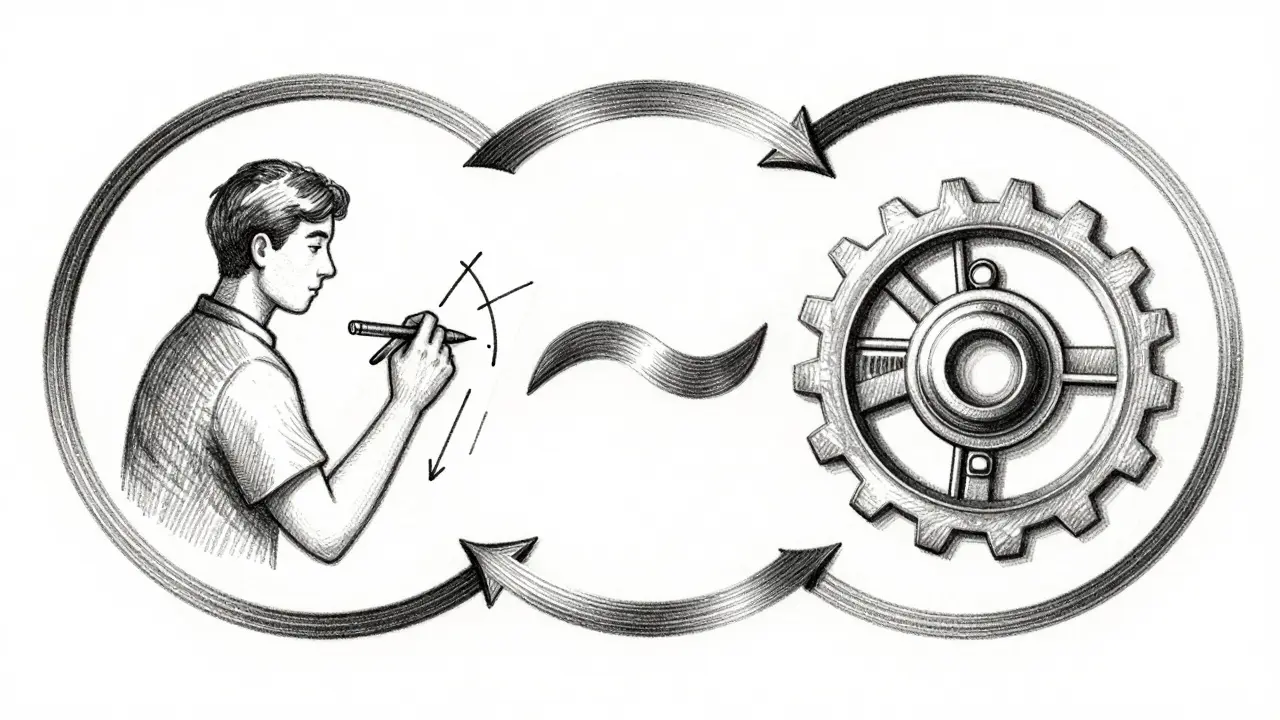
Evaluation doesn't end when the model is deployed. User behavior changes, and models drift. Tier 3 ensures that corrections made by humans in Tier 2 feed back into the training data. Real-time interfaces let QA teams annotate failure cases as they appear in production. This creates a continuous improvement cycle where the model gets better every week based on real-world human feedback.
Smart Routing: Uncertainty and Diversity Sampling
The secret sauce of a HITL pipeline is not just *who* reviews the content, but *what* gets reviewed. If you send every low-scoring output to a human, you’ll waste time on obvious errors. If you only send high-stakes errors, you might miss systemic issues. You need intelligent sampling strategies.
Uncertainty Sampling routes outputs where the LLM judge shows low confidence. If your automated evaluator assigns a probability score to its judgment, anything near the decision boundary (e.g., 49% vs 51%) goes to a human. This focuses human expertise on genuinely ambiguous cases where the AI needs guidance.
Diversity Sampling ensures you aren't just evaluating common patterns. If your model performs well on simple questions but poorly on complex legal queries, diversity sampling forces the pipeline to pull examples from underrepresented categories. This prevents blind spots in your automated calibration. Without this, your AI might become excellent at answering trivia but terrible at handling nuanced customer complaints.
| Strategy | Primary Goal | Best Used For | Limitation |
|---|---|---|---|
| Automated Screening | Speed & Volume | Basic coherence, PII leaks, format checks | Misses nuance and context |
| Uncertainty Sampling | Calibration | Ambiguous cases where AI confidence is low | Requires probabilistic outputs from judges |
| Diversity Sampling | Bias Mitigation | Ensuring coverage across rare or edge-case topics | Can dilute focus on high-frequency errors |
| Random Sampling | Baseline Health | General quality assurance audits | Inefficient; wastes time on obvious good/bad cases |

Mitigating Bias Through Human Oversight
AI models learn from data, and data is full of human bias. An automated system will happily amplify stereotypes if they exist in its training set. A pure LLM-as-a-Judge might also inherit these biases, penalizing certain dialects or perspectives unfairly. This is why the "human" in HITL is non-negotiable for fairness.
During the evaluation phase, human reviewers act as a safeguard. They identify biased outputs that automated metrics miss. For instance, an automated judge might rate a response highly for "professionalism," but a human reviewer might notice it uses gendered language or excludes diverse viewpoints. By correcting these instances, humans provide the negative reinforcement needed to steer the model toward fairness. This dual purpose-improving accuracy while enforcing ethical standards-is what makes HITL essential for high-stakes applications like healthcare, finance, and legal tech.
Implementing Real-Time Feedback Loops
Static evaluation is dead. In 2026, models evolve continuously. Your pipeline must support real-time operational mechanisms. When a user flags a bad response in your app, that data shouldn't sit in a database waiting for a monthly report. It should trigger an immediate alert in your HITL dashboard.
Product and QA teams need tools to annotate these failure cases instantly. Imagine a developer seeing a spike in negative sentiment around a specific feature. With a proper HITL setup, they can pull up the exact conversations, see why the model failed, and push a correction. Analytics tools then track how this human input shifts model behavior over time. This visibility allows domain experts to contribute corrections in context, ensuring updates are grounded in real data rather than guesswork.
Common Pitfalls to Avoid
Even with the best intentions, HITL pipelines can fail if implemented poorly. Here are the traps to watch out for:
- Evaluator Fatigue: If your Tier 1 filter is too loose, humans get overwhelmed with obvious errors. Tighten your automated criteria to ensure humans only see cases that actually require thought.
- Lack of Rubric Consistency: Humans disagree. If one reviewer rates a summary as "good" and another as "bad," your ground truth data becomes noisy. Use structured rubrics and regular calibration sessions among your human reviewers.
- Ignoring Disagreement: When multiple LLM judges disagree on an output, don't just pick the majority vote. Escalate these disagreements to human review. These are the highest-value learning opportunities for your system.
- Static Prompts: Your evaluation prompts need to evolve as your model does. What worked for version 1.0 might be irrelevant for version 2.0. Treat your evaluation criteria as living documents.
Conclusion: The Hybrid Future of AI Quality
There is no silver bullet for evaluating Large Language Models. Automation gives you scale, but humans give you trust. By building a tiered HITL pipeline that uses uncertainty sampling, diversity checks, and real-time feedback loops, you create a system that improves itself. You stop guessing whether your model is safe and start knowing. As AI capabilities grow more sophisticated, the role of the human evaluator shifts from grunt work to strategic oversight. Embrace that shift, and you’ll build AI products that are not just smart, but reliable.
What is the primary benefit of using Human-in-the-Loop (HITL) for LLM evaluation?
The primary benefit is balancing scalability with accuracy. Automated systems can evaluate millions of outputs quickly, but they lack nuance. HITL pipelines use automation for routine checks and route complex, ambiguous, or high-stakes cases to human experts, ensuring high quality without burning out your team.
How does uncertainty sampling improve HITL efficiency?
Uncertainty sampling identifies cases where the automated AI judge is unsure (e.g., scores near a decision boundary). By routing only these ambiguous cases to humans, you focus expert attention on the areas where the AI needs the most guidance, rather than wasting time on obvious correct or incorrect answers.
Can LLM-as-a-Judge replace human evaluators entirely?
No. While LLM-as-a-Judge achieves over 80% agreement with humans on general tasks, it struggles with bias, nuance, and edge cases. It serves best as a first-tier filter. Human oversight remains essential for safety, fairness, and handling complex domain-specific requirements.
What are the key components of a tiered HITL architecture?
A tiered architecture typically includes: 1) Automated Screening for basic quality and safety checks, 2) Human Review for flagged edge cases and ambiguous outputs, and 3) Continuous Feedback Loops where human corrections retrain and calibrate the automated systems.
How does HITL help mitigate AI bias?
Humans can identify subtle biases and unfairness that automated metrics miss. By reviewing flagged outputs and providing corrections, humans create ground-truth data that retrains the model to avoid biased patterns, ensuring fairer and more inclusive AI outputs.


