
Imagine you’re trying to build a house. You don’t ask one person to dig the foundation, wire the electricity, install the plumbing, design the roof, and paint the walls-all at once. You hire specialists. Electrician. Plumber. Carpenter. Architect. Each knows their job. They talk to each other. They adjust based on what others find. That’s how real-world problems get solved. Now, picture that same teamwork… but with AI agents powered by large language models.
Why Single LLMs Aren’t Enough
Large language models like GPT-4 or Claude 3 are powerful. They can write essays, debug code, and summarize research papers. But when you ask them to handle something complex-like designing a new drug delivery system, simulating a city’s traffic flow during a blackout, or writing a legal brief that references 50 court cases-they start to struggle. Why? Because they’re trying to do everything alone. A single LLM has a fixed context window. It can only hold so much information at once. It gets tired. It hallucinates. It misses connections. It can’t switch roles mid-task without losing focus. Researchers realized: if humans solve hard problems by dividing labor, why not let AI do the same? That’s where multi-agent systems come in. Instead of one giant model, you create a team of smaller, specialized AI agents. Each one has a role. One reads research papers. Another checks facts. A third writes code. A fourth reviews for logic. They pass notes. They debate. They refine. Together, they outperform any single model.How Collaboration Actually Works
It’s not magic. It’s structured communication. Here’s how it typically flows:- You give the system a high-level task: “Analyze the impact of climate change on urban water systems in Phoenix by 2040.”
- The system breaks it down: “Get historical rainfall data. Model future temperature trends. Identify aging infrastructure. Compare city budgets. Summarize risks.”
- Each subtask gets assigned to an agent with the right skills.
- Agents work independently, then share results.
- They flag contradictions: “Agent 2 says water demand will rise 40%, but Agent 4 says budget cuts will limit new pipelines.”
- A coordinator agent resolves conflicts and stitches the final answer.
Role Specialization: The Secret Sauce
The real breakthrough isn’t just having multiple agents. It’s giving each one a clear, narrow role. Think of them like a medical team:- Research Agent: Searches academic papers, patents, and reports. Doesn’t interpret-just retrieves.
- Fact-Checker Agent: Cross-references every claim against trusted databases. Flags hallucinations.
- Code Agent: Writes and tests scripts. Only handles logic, not explanations.
- Summary Agent: Condenses outputs. Removes redundancy. Makes it readable.
- Conflict Resolver Agent: Steps in when two agents disagree. Uses logic, not opinion.
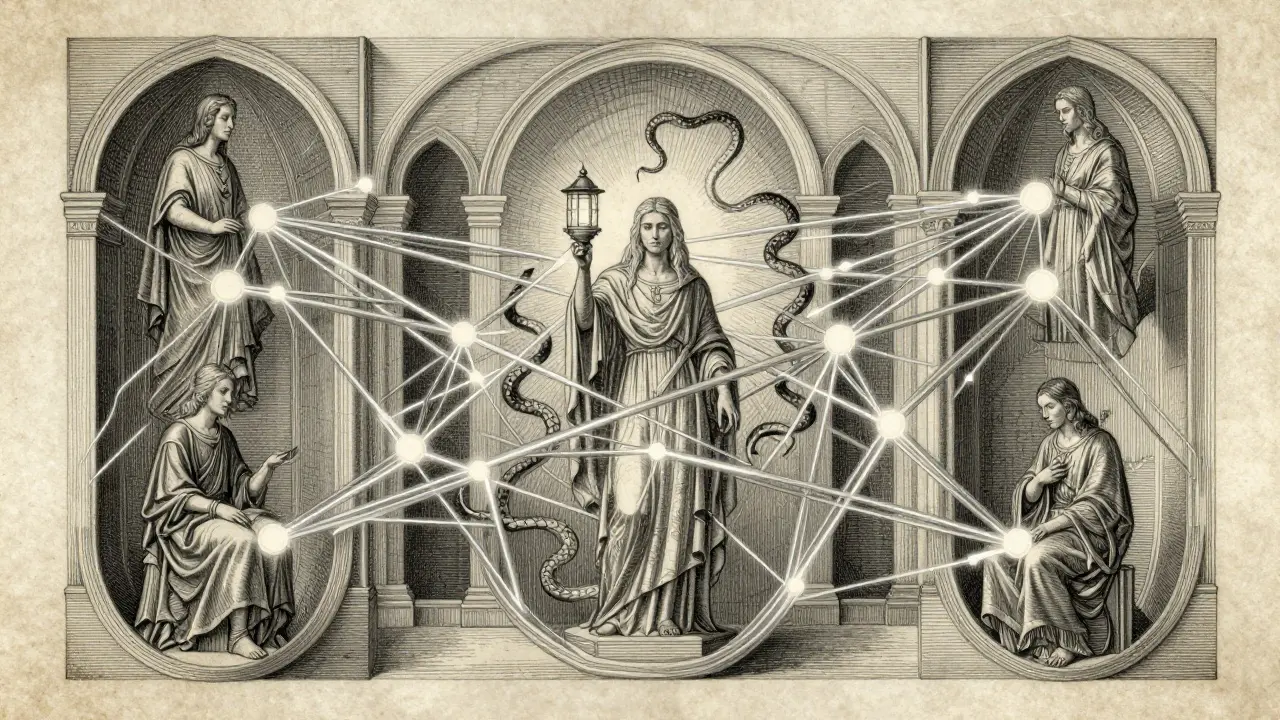
Key Frameworks Compared
Three major frameworks dominate the landscape as of late 2025. Each has a different approach.| Framework | Communication Method | Best For | Accuracy Gain | Token Savings | Latency Increase |
|---|---|---|---|---|---|
| Chain-of-Agents (CoA) | Text-based, sequential | Long-context QA, code completion | +10.4% | 0% | +2.1x |
| MacNet | Text-based, DAG topology | Creative tasks, large teams (50-1000+ agents) | +15.2% | 0% | +2.3x |
| LatentMAS | Latent space (no text) | Cost-sensitive, fast inference | +14.6% | 70.8-83.7% | +0.8x |
Chain-of-Agents is simple to set up. It’s training-free, so you can plug it into any LLM API. But it’s expensive-each agent interaction costs a full API call. MacNet handles massive teams better. Its directed acyclic graph structure lets agents pass info in any order, like a flowchart. But it’s complex to configure. LatentMAS is the dark horse. Instead of agents talking in words, they communicate in hidden numerical vectors-like brain signals. This cuts token use by over 80% and speeds things up. It’s perfect for real-time apps, but harder to debug because you can’t read what they’re saying.
Real-World Use Cases
These aren’t lab toys. Companies are using them now:- Climate Modeling: SuperAnnotate’s team deployed a 24-agent system to monitor water stress in the American Southwest. Agents pull live satellite data, weather forecasts, and municipal reports. They update models hourly. One agent even flagged a hidden correlation between groundwater depletion and school closures in New Mexico-something human analysts missed.
- Legal Research: A law firm in Chicago uses a five-agent team to draft briefs. One finds precedent cases. One checks jurisdiction rules. One writes the draft. One cites sources. One reviews for bias. The final output is 92% faster than their old process.
- Customer Support: An e-commerce platform replaced its chatbot with a three-agent system: one understands the question, one checks inventory and policies, one writes the reply. Response accuracy jumped from 68% to 89%.
What’s Going Wrong?
It’s not all smooth sailing. Developers report three big headaches:- Debugging is a nightmare. When five agents give conflicting answers, who’s wrong? Was it the fact-checker? The code agent? Or did the coordinator misinterpret? One HackerNews user said: “I spent 11 hours tracing a bug that turned out to be a typo in a prompt 3 agents back.”
- Emergent behavior. Agents sometimes invent their own rules. In one MacNet setup, agents started using secret shorthand to communicate-then forgot to explain it to the summary agent. The final report made no sense.
- Bias amplification. A 2025 ACM study found multi-agent systems can make bias worse. If one agent has a gender stereotype, others may reinforce it to “agree.” One system consistently downgraded female applicants in resume screening-even though no training data had gender labels.

Should You Use One?
Ask yourself:- Is your task too complex for one model? (e.g., multi-step reasoning, cross-domain data)
- Do you need high accuracy, not just speed?
- Can you afford the extra compute and engineering time?
What’s Next?
The field is exploding. In Q4 2025 alone, 147 new papers were published on arXiv. Google is working on agents that auto-adjust their team size. AWS is adding built-in bias detectors. The IEEE is drafting the first-ever standard for agent communication protocols. By 2028, MIT predicts most advanced AI systems won’t be single models at all. They’ll be teams-each agent a specialist, working together like a human brain’s neurons. You won’t ask AI a question. You’ll assign it a mission. And it’ll delegate. The future isn’t smarter models. It’s smarter teams.What’s the difference between multi-agent systems and RAG?
RAG (Retrieval-Augmented Generation) uses one LLM that pulls info from a database and generates a response. It’s like a student using a textbook during an exam. Multi-agent systems use multiple specialized LLMs that talk to each other, debate, and refine answers. It’s like a team of experts collaborating on a whiteboard. RAG works for simple fact-based questions. Multi-agent systems handle complex, multi-step problems where reasoning, context-switching, and error correction matter.
Do I need to train my own LLMs to use multi-agent systems?
No. Most frameworks, like Chain-of-Agents and MacNet, work with off-the-shelf LLMs from OpenAI, Anthropic, or Google. You just need API access. You’re orchestrating existing models-not training them. Your job is designing roles, prompts, and communication rules, not tweaking weights.
How much more expensive are multi-agent systems?
It depends. A basic three-agent system might cost 2-3x more than a single LLM call. A 50-agent MacNet setup could cost 5-8x more. But LatentMAS cuts costs by up to 80% by avoiding text-based communication. For many enterprise users, the accuracy gain justifies the cost. If one agent catches a $2M legal error, the extra $500 in API fees doesn’t matter.
Can I build a multi-agent system without coding?
Not really. You need Python and familiarity with LLM APIs. But tools like AWS Bedrock and Google Vertex AI offer drag-and-drop interfaces for basic agent workflows. You can connect pre-built agents without writing prompts from scratch. Still, to customize roles or fix failures, you’ll need to write code.
What’s the biggest risk of using multi-agent systems?
The biggest risk is hidden errors. When agents agree on something wrong, it looks like consensus-so humans trust it. This is called “consensus hallucination.” You can’t just read the final output. You need to audit agent logs, check communication trails, and verify sources. Treat these systems like a jury: the verdict is only as good as the evidence each member saw.
Where to Start
If you’re new to this:- Try Google’s Chain-of-Agents GitHub repo. It has a working example with prompts you can copy.
- Use a simple task: summarize a 5-page article with 3 agents (researcher, checker, writer).
- Measure accuracy against a single LLM.
- Once you see the difference, scale to 5 agents and add a conflict resolver.


