
When you use generative AI to write product descriptions, patient education materials, or financial reports, you’re not just hitting ‘generate’ and calling it done. You’re betting your brand’s credibility on output that can sound perfect but be dangerously wrong. That’s why quality metrics for generative AI content aren’t optional-they’re your last line of defense against misinformation, brand damage, and compliance failures.
Readability: Is Your AI Content Actually Understandable?
Readability isn’t about fancy words or long sentences. It’s about whether your audience can grasp the message without needing a dictionary or a PhD. For healthcare content, the National Institutes of Health requires a Flesch Reading Ease (FRE) score above 80. That means sentences like “The medication reduces inflammation by inhibiting COX-2 enzymes” get flagged-not because they’re wrong, but because they’re too dense for the average patient. AI tools that score content on FRE, Flesch-Kincaid Grade Level, or Gunning Fog Index can instantly tell you if you’re speaking at a 12th-grade level when your audience reads at a 6th-grade level. Most enterprise platforms now track these scores in real time. Magai’s tool, for example, shows you how changing one sentence lifts your FRE from 72 to 83. But here’s the catch: oversimplifying hurts accuracy. If you force every technical term out to hit a 90 FRE score, you might lose critical nuance. A fintech company in Chicago learned this the hard way when their AI rewrote SEC-compliant disclosures into plain language-only to remove key legal qualifiers. Their accuracy score crashed. The sweet spot? Match your readability target to your audience. B2B technical content? Aim for FRE 65-70. Consumer health? 75-80. Educational content? 70-75. Tools like Conductor’s AI Content Score let you set custom thresholds so your AI doesn’t chase a perfect score at the cost of clarity.Accuracy: When AI Gets It Wrong, People Get Hurt
Accuracy is where most AI content fails silently. A study in the Journal of Medical Internet Research found that 38% of AI-generated medical summaries contained at least one factual error-like misstating drug interactions or omitting contraindications. These aren’t typos. They’re life-risking mistakes. That’s why reference-free accuracy metrics like FactCC and SummaC are now standard. Unlike older tools that just checked for plagiarism, these analyze whether the AI’s output logically follows from its source material. Microsoft’s 2024 benchmarks show SummaC detects contradictions in medical text with 91.2% accuracy. It doesn’t need you to provide the “correct” answer-it just asks: Does this claim contradict what was stated in the source? But even the best tools have blind spots. Dr. Emily Bender at the University of Washington warns that current systems miss 23% of subtle factual errors, especially in complex fields like law or finance. That’s why no company relying on AI for compliance documents uses just one metric. They layer them: FactCC for broad fact-checking, QAFactEval for precision, and SRLScore to catch misattributed claims. One legal firm in Atlanta runs all three on every AI-generated contract clause. Their error rate dropped from 14% to 2% in six months. The biggest risk? Trusting a high accuracy score without human review. A healthcare publisher in New Mexico saw their AI score a false claim about a new treatment as “98% accurate” because it matched a retracted study. Human editors caught it. No metric replaces context.Consistency: Keeping Your Brand Voice From Going Off the Rails
Imagine your AI writes a blog post in a casual, friendly tone-then the next one sounds like a corporate legal brief. That’s inconsistency, and it erodes trust faster than a factual error. Consistency metrics measure tone, style, and voice alignment. Tools like Acrolinx and Galileo compare AI output against your brand’s style guide-word choices, sentence length, formality level, even punctuation habits. In a 2024 case study, a SaaS company reduced content revision cycles by 43% after implementing these metrics. Their AI now auto-corrects “utilize” to “use,” avoids passive voice, and sticks to their defined tone: confident but approachable. But here’s the nuance: consistency isn’t about sameness. It’s about appropriateness. A customer support chatbot should sound different from a whitepaper. The best systems let you define multiple voice profiles-“technical,” “casual,” “formal”-and assign them by audience or channel. One financial services firm uses three: “Investor Report” (precise, data-heavy), “Client Email” (warm, simplified), and “Social Post” (concise, punchy). The AI switches modes automatically based on the output destination. The catch? Most tools require upfront work. You need to feed them 50-100 examples of your best content so they learn your voice. That’s not magic-it’s training. And if your style guide is vague (“be professional”), the AI will guess. Be specific: “Use active voice. Avoid jargon. Never use ‘leverage.’”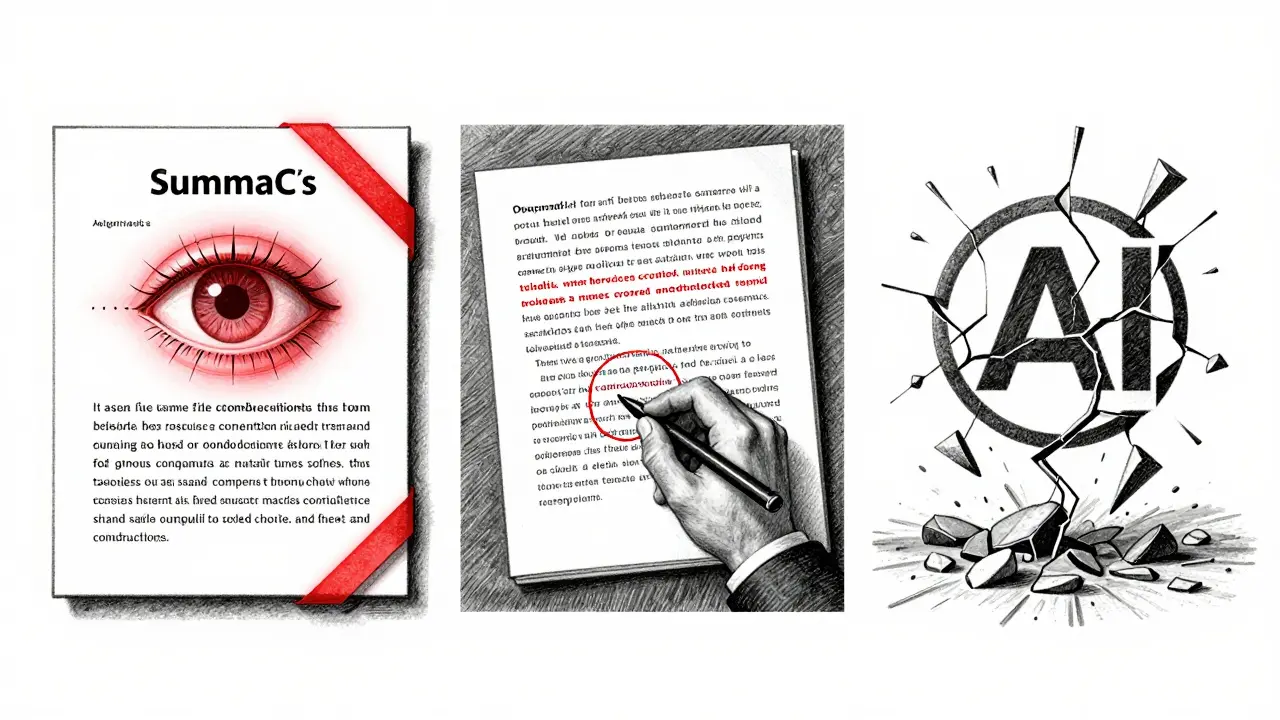
How the Best Teams Combine Metrics
No single metric tells the whole story. The top-performing teams use a weighted scoring system. Conductor’s AI Content Score, used by 200+ enterprises, weights readability at 25%, accuracy at 35%, and consistency at 40%. Why? Because a perfectly readable but false or inconsistent piece is worse than one that’s slightly hard to read but trustworthy. Here’s what a real workflow looks like:- Generate content with your AI tool.
- Run it through a readability checker (FRE target: 75 for consumer health).
- Pass it to a factuality engine (SummaC + QAFactEval).
- Compare tone and style against your brand profile in Acrolinx.
- If any score falls below threshold, the system flags it for human review.
- Human editor makes final call-especially if the topic is high-risk.
What You Can’t Automate (And Why You Still Need Humans)
Even the best metrics fail in three areas:- Contextual nuance: AI can’t tell if a joke is inappropriate for a grieving family.
- Regulatory gray zones: A claim might be technically true but misleading under SEC or FDA rules.
- Emerging misinformation: If a new rumor spreads online, AI has no way to know it’s false unless it’s already documented.

Where the Industry Is Headed
The next wave of AI quality tools will be smarter. Microsoft’s Project Veritas, now in beta, checks image-text alignment-so if your AI generates a chart saying “sales up 200%” but the image shows a flat line, it flags it. Google’s research shows AI can now adjust complexity in real time based on reader behavior-if someone rereads a sentence, the system simplifies the next one. The W3C is also working on open standards so tools from different vendors can talk to each other. Right now, you might get a 72 score from one tool and a 68 from another for the same piece. That’s chaos. Standardization is coming-and it’s needed.How to Start
If you’re new to this, don’t try to build everything at once. Start here:- Identify your highest-risk content: compliance docs, medical info, financial summaries.
- Pick one metric to measure: Start with Flesch Reading Ease. It’s free, simple, and tells you if your content is readable.
- Set a threshold: 75 for general audiences, 80+ for healthcare.
- Run 10 AI-generated pieces through it. See how many fail.
- Bring in a human editor. Ask: “Would a real person understand this?”
- Then add accuracy checks. Use FactCC or a free tool like FactCheckGPT.
- Finally, lock in your brand voice with a simple style guide and Acrolinx or similar.
What’s the most important AI content quality metric?
There’s no single most important metric-it depends on your use case. For healthcare or public-facing content, readability (FRE >80) is critical to ensure understanding. For legal or financial content, accuracy (using SummaC or QAFactEval) matters most because errors can lead to compliance violations. For brand-heavy content like marketing or customer communications, consistency in tone and voice is key. The best approach combines all three with weighted scoring, where accuracy often carries the highest weight.
Can AI tools automatically fix readability issues?
Yes, tools like Magai and Acrolinx can suggest edits to improve readability-shortening sentences, replacing jargon, or splitting complex ideas. But they can’t always do it right. Forcing simplicity often removes nuance. An AI might change “the patient’s condition deteriorated due to uncontrolled hypertension” to “the patient got worse from high blood pressure.” The second is easier to read, but loses clinical precision. Always review automated edits, especially for technical or medical content.
How do I know if my AI is generating factually inaccurate content?
Use reference-free factuality tools like SummaC or FactCC. These don’t rely on a “correct” answer-they check if the AI’s output contradicts its source material. For example, if your source says “Drug X reduces risk by 30%,” but the AI says “Drug X cures the disease,” the tool flags it as inconsistent. Run your AI output through at least two different tools to reduce false positives. Human review is still required for complex topics where context matters more than wording.
Why do different AI tools give different scores for the same content?
Because there are no universal standards yet. Each vendor uses different algorithms, training data, and weighting. One tool might count passive voice as a readability penalty; another doesn’t. One might penalize domain-specific terms like “quantum entanglement,” while another treats them as neutral. This leads to up to 47% variance in scores across platforms, according to Forrester. To avoid confusion, pick one primary tool for your workflow and stick with it. Don’t compare scores across tools.
Do I need special hardware to run these metrics?
No. Most quality metrics run via cloud APIs, so you don’t need powerful local machines. Tools like Acrolinx, Magai, and Conductor are SaaS platforms-you just paste your text or connect your CMS. Minimum requirements are basic: a modern browser and internet access. The heavy lifting happens on the vendor’s servers. Even small teams can use these tools without IT support.
What’s the biggest mistake companies make when using AI quality metrics?
They treat the metrics as a final answer instead of a warning system. A high score doesn’t mean the content is perfect-it just means it passed a set of automated checks. The biggest failures happen when teams automate approval based on scores alone. One fintech company did this and ended up publishing AI-generated disclosures with incorrect interest rates because the metric missed a subtle misstatement. Always add human review for high-stakes content. Metrics guide you. Humans decide.


