
Want your AI-generated content to sound like a seasoned copywriter, a casual TikTok creator, or a formal legal brief-all from the same prompt? That’s the power of style transfer prompts. It’s not just about what the AI says. It’s about how it says it. And mastering this isn’t magic. It’s a system.
What Exactly Is Style Transfer in AI?
Style transfer in AI means taking the way something is written or designed and applying it to something else-without changing the core message. Think of it like putting a Van Gogh painting over a photo of your cat. The cat stays the cat. But now it’s swirling, brushy, and dramatic. In text, this works the same way. You give the AI a sample of writing-say, a tweet from Elon Musk-and ask it to rewrite your product description in that same tone. The result? A version that feels like it came from the same person, even though it’s brand new content. This isn’t new. The concept started in image generation back in 2015 with neural style transfer. But now, with large language models like GPT-4, Claude 3, and Gemini, we can do it with words. And businesses are using it to scale brand voice across thousands of ads, emails, and product descriptions.Why Tone, Voice, and Format Matter More Than You Think
Tone is how the message feels: playful, serious, sarcastic, urgent. Voice is who’s speaking: a CEO, a teenager, a robot, a grandmother. Format is how it’s structured: bullet points, paragraphs, dialogue, hashtags. Most people treat AI like a typewriter. You type a prompt. It spits out text. But if you don’t control these three elements, you get inconsistent, confusing, or even brand-damaging output. Take a real example: A fintech startup uses AI to write customer emails. Without style control, one email sounds like a bank brochure (“We are pleased to inform you…”), the next sounds like a meme (“Bro, your loan’s approved 😎”). That’s not branding. That’s chaos. Companies like Adobe and AdCreative.ai report a 37% boost in ad engagement when tone and voice are consistent across campaigns. Why? Because people trust patterns. They recognize a voice. And they respond to familiarity.How Visual Style Transfer Works (And Why It’s Easier)
Visual style transfer is the older, simpler cousin of text style transfer. Tools like Adobe Firefly let you pick an image-say, a watercolor painting-and apply its colors, textures, and brushstrokes to another photo. You click. Done. Under the hood, it uses convolutional neural networks (CNNs) to separate style (color, texture) from content (shapes, objects). The AI doesn’t care if you’re turning a dog into a Van Gogh. It just matches the brushstroke patterns. That’s why visual style transfer scores around 91% accuracy in keeping the intended look. The rules are visual. Measurable. Objective. But text? That’s a different story.
Text Style Transfer Is Messier-Here’s How to Tame It
Language is full of nuance. A joke isn’t just about word choice-it’s about timing, cultural references, irony. A formal email isn’t just longer sentences. It’s passive voice, no contractions, no exclamation points. So how do you teach an AI to copy that? The most reliable method? Build a style guide from examples. Here’s how Christopher Penn’s method works in practice:- Collect 10-20 real pieces of content that represent your ideal voice. These could be past emails, social posts, or even competitor content you admire.
- Feed them into the AI with this prompt: “You’re an expert in style analysis. Read these samples and describe the author’s writing style in bullet points. Focus on tone, sentence length, word choice, punctuation, and structure.”
- Take the output-your style guide-and turn it into a reusable prompt template.
- Tone: Friendly, slightly sarcastic, no corporate jargon
- Voice: Like a smart friend who explains things without talking down
- Sentence length: Short. Average 12 words. Often ends with a punchline.
- Word choice: Uses contractions (you’re, don’t), avoids passive voice
- Punctuation: Uses em dashes - like this - for emphasis. Rarely uses exclamation points.
Common Mistakes (And How to Fix Them)
Even with a good style guide, things go wrong. Here are the top three issues-and how to solve them.1. Style Drift
The AI starts strong, then halfway through, it forgets the tone. It slips into generic corporate speak. Fix: Reassert the style every 3-4 sentences. Add a reminder like: “Remember: short sentences. Sarcasm. No jargon.” in the middle of long outputs.2. Over-Application
You ask for “Winston Churchill tone,” and the AI turns a product launch into a WWII speech. Fix: Use style intensity sliders if your tool supports them. Adobe Firefly 2.3 lets you set style strength from 1-100%. Start at 30%. You can always crank it up.3. Semantic Distortion
The style changes so much that the meaning gets lost. You wanted “funny” and got “nonsensical.” Fix: Always compare the output to the original. Ask: “Does this say the same thing, just in a different voice?” If not, reset. Use smaller chunks of text. Don’t try to rewrite a 2,000-word blog in one go.Tools That Actually Work (As of 2026)
Not all AI tools handle style transfer well. Here’s what’s reliable right now:| Tool | Best For | Style Control | Limitations |
|---|---|---|---|
| Adobe Firefly 2.3 | Visual style transfer | Style intensity slider (1-100%), reference image + text prompt | No text style transfer. Limited fine-tuning for pros. |
| AdCreative.ai | Marketing copy, ad variations | Pre-built brand voice templates, audience-specific tone presets | Only for advertising. No long-form content. |
| Tencent Cloud StylePrecision | Hybrid visual + text | Text prompts + reference images. 22% higher accuracy than older versions | Enterprise-only. No public API yet. |
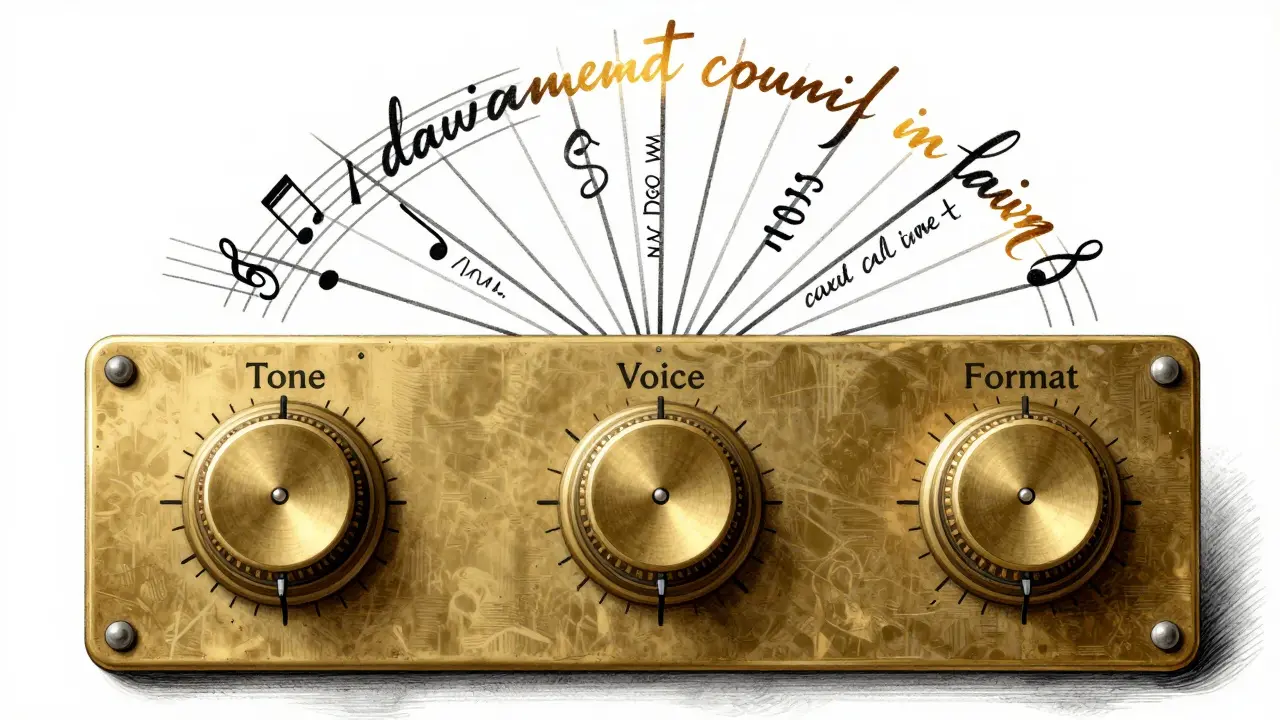
| Claude 3.5 (Q1 2025) | Advanced text style control | Style vectors: adjust tone, voice, and format independently | Not publicly available yet. Requires API access. |
What’s Coming Next
By 2026, 70% of enterprise content will use AI style transfer, according to Gartner. The next leap? Independent control over tone, voice, and format as separate dials. Imagine this: You’re writing a product manual. You want:- Tone: Professional
- Voice: Technical expert
- Format: Step-by-step with numbered instructions
Start Small. Test Fast.
You don’t need to overhaul your whole content workflow. Start with one piece of content. Pick one channel. Try one style. Example: Take your next Instagram caption. Rewrite it in the voice of your favorite influencer. Use the bullet-point style guide method. Compare the two versions. Which one gets more likes? More saves? Track it. Learn from it. Then scale. Style transfer isn’t about replacing writers. It’s about giving them superpowers. The best content creators aren’t the ones who write the most. They’re the ones who can adapt their voice to any audience-and do it fast. Your AI can do that too. If you know how to ask.Can I use style transfer prompts with free AI tools like ChatGPT?
Yes, but with limits. Free versions of ChatGPT have shorter context windows (usually 8K-16K tokens), so they struggle with long style guides or complex prompts. You can still use the bullet-point style guide method, but you’ll need to break longer texts into chunks. For best results, upgrade to a paid plan with larger context (like GPT-4 Turbo or Claude 3 Opus).
Does style transfer work for non-English languages?
Yes, but quality varies. Models trained on English data perform best. For other languages, you need high-quality local examples to build your style guide. Spanish, French, and Japanese models are improving fast, but for languages with less training data, you’ll see more errors in tone and idioms. Always test with native speakers.
How do I prevent my brand voice from being copied by competitors using AI?
There’s no foolproof way to stop someone from reverse-engineering your style if your content is public. But you can make it harder. Use unique phrasing, internal jargon, or cultural references that outsiders won’t understand. Also, consider watermarking your AI output with a subtle signature phrase (like “-Powered by [Brand] Voice Engine”) to deter direct copying.
What’s the difference between style transfer and fine-tuning an AI model?
Style transfer uses prompts to change output on the fly. Fine-tuning re-trains the AI model itself on your data, which takes weeks, costs thousands, and requires technical expertise. Style transfer is like putting on a new shirt. Fine-tuning is like getting a whole new body. For most users, style transfer is faster, cheaper, and flexible enough.
Is style transfer just a fancy way to plagiarize?
No-if you’re using it ethically. Style transfer mimics tone and structure, not exact words. Copying a competitor’s article word-for-word is plagiarism. Using their tone to write your own original message is branding. The key is originality in content and transparency in intent. Always disclose AI use when required by law or platform policy.


