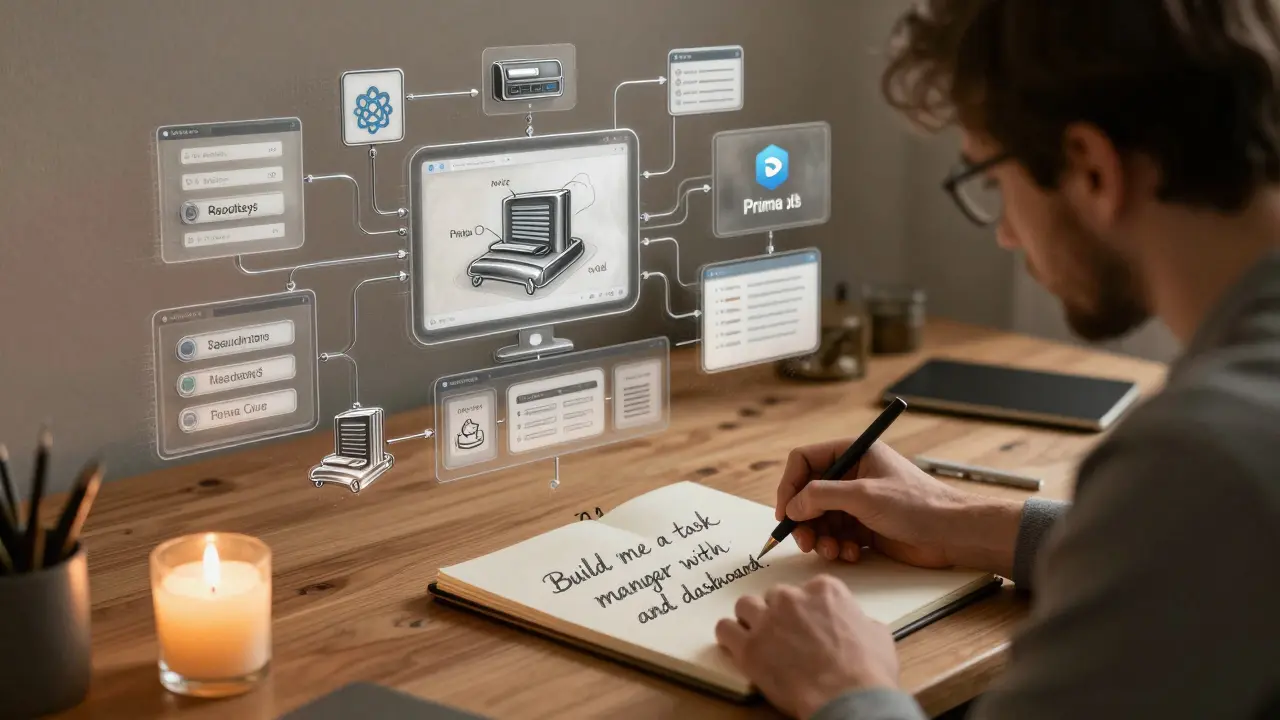
Imagine typing a simple sentence like "Build me a task manager with user login, a dashboard, and a database to save tasks" - and getting a working app in under 30 minutes. No staring at error logs for hours. No copying Stack Overflow snippets. No wrestling with frameworks you barely understand. That’s vibe coding in 2026. It’s not magic. It’s not sci-fi. It’s what happens when AI finally gets good enough to build full-stack apps from plain English.
What Vibe Coding Actually Means Right Now
Vibe coding isn’t about letting AI replace you. It’s about letting AI handle the boring, repetitive parts so you can focus on the hard stuff. According to Google Cloud’s 2025 definition, it’s using AI to generate functional code from natural language prompts. That means you describe what you want - not how to code it. The AI figures out the rest: backend APIs, frontend React components, database tables, authentication flows, even deployment configs. This isn’t theory. Developers are doing it. One solo builder on Hacker News shipped a full SaaS app in 11 days using vibe coding. The same project would’ve taken 8 to 10 weeks the old way. That’s not a fluke. It’s happening because the tools got smarter. GitHub Copilot’s Sonnet 4.5 model now handles 1 million tokens of context - enough to remember your entire project structure across multiple prompts. Emergent’s platform uses multiple AI agents working in parallel: one for the frontend, one for the backend, one for the database. They talk to each other. They catch inconsistencies. It’s not perfect, but it’s fast.What You Can Actually Build With It
Vibe coding shines in predictable, structured applications. Think CRUD apps - things that create, read, update, and delete data. A customer portal. An internal inventory tracker. A simple e-commerce admin panel. These are the sweet spot. Success rates for these kinds of apps hit 88% on the first try, according to Emergent’s Q4 2025 data. Here’s what happens when you ask for a basic vertical slice - a single feature built end-to-end:- You say: "Add user login with email and password"
- AI generates: a login form (React), a user model (Prisma), an API route (Node.js), a JWT auth middleware, and a database migration
- Time spent: 15-20 minutes
Where It Falls Apart
Don’t get fooled. Vibe coding isn’t a magic wand. It struggles hard with anything complex, unusual, or performance-sensitive. Try asking for: "Build a real-time stock ticker with WebSocket streaming and 10ms latency". Success rate drops to 45%. The AI doesn’t know how to optimize network buffers or handle connection pooling. It might generate code that works - but it’ll be slow, bloated, or crash under load. Or try: "Implement a custom encryption algorithm for HIPAA compliance". The AI will hallucinate. It might invent non-existent libraries. It might use outdated crypto methods. GitHub’s internal analysis shows AI only anticipates 62% of edge cases without you spelling them out. You have to think like an architect, not just a prompter. Debugging AI-generated code is the biggest pain point. Sixty-seven percent of negative feedback on Reddit and Hacker News mentions this. The AI writes code that looks right - but has subtle bugs. A variable named wrong in one file. A missing dependency. A route that doesn’t match the frontend call. You can’t just read the error and fix it. You have to reverse-engineer what the AI was thinking.
How to Start Without Getting Lost
If you’re new to this, don’t jump in blind. Follow a structure. The Wasp.dev team calls it the 3-Ps: patience, persistence, planning. Start here:- Setup (2-4 hours): Install VS Code + GitHub Copilot (Sonnet 4.5). Pick Wasp or Laravel. Don’t try to use React + Express + MongoDB unless you already know all three.
- Plan (3-6 hours): Sketch your app as vertical slices. List features one by one: login, dashboard, profile page, notifications. Prioritize. Don’t try to build everything at once.
- Build (15-30 min per slice): For each feature, write one clear prompt. "Add a profile page that shows user name, email, and allows photo upload. Save to database. Show on dashboard." Let the AI generate the code. Test it. If it fails, don’t rewrite the prompt. Ask: "Why didn’t the upload work?" Let the AI debug.
- Review (1 hour per 3 slices): Step back. Look at the code. Does it make sense? Are files organized? Are naming conventions consistent? If not, fix it manually. The AI doesn’t care about clean code - you do.
Who’s Using This, and Why
The adoption numbers tell a clear story. In Q4 2025, the vibe coding tools market hit $1.2 billion. 68% of users are professional developers - not beginners. They’re not trying to replace themselves. They’re using vibe coding to build internal tools, prototypes, and boilerplate features 20 to 50 times faster. Forty-two percent of Fortune 500 companies are piloting it. Why? Because it cuts time-to-market. A marketing team can get a landing page with form submissions and email capture built in a day, not a week. A product manager can test an idea without waiting for engineering bandwidth. But here’s the twist: 22% are citizen developers - non-coders building tools for their teams. And 10% are students. For them, vibe coding is a shortcut to understanding how apps work. They see code being generated and learn by watching it. The real winners? Those who treat it like a co-pilot, not a pilot. You still need to understand the basics: what a database is, how HTTP requests work, what a route does. You don’t need to write it - but you need to know if it’s right.
The Future Is Structured
The next wave is coming fast. GitHub is adding integrated security scanning for AI-generated code in Q2 2026. Microsoft is building real-time collaborative vibe coding for Q3. Emergent is working on industry-specific models for healthcare and finance - tuned to HIPAA and PCI standards. But the biggest shift isn’t technical. It’s cultural. In 2025, 61% of tech leads worried about maintainability. By 2026, that’s dropping. Why? Because teams are starting to document their vibe coding rules. They’re creating shared prompt libraries. They’re reviewing AI output in pull requests. They’re treating AI-generated code like any other code - with standards, reviews, and tests. This isn’t the end of developers. It’s the end of tedious coding. The future belongs to those who can think clearly, ask the right questions, and guide the AI - not replace it.What to Expect in the Next 12 Months
If you start today, here’s what you’ll see:- By Q2 2026: AI will catch 80% of security flaws in generated code - no more manual audits for basic apps.
- By Q3 2026: You’ll be able to work side-by-side with another developer in the same AI session. Both of you type prompts. The AI synthesizes both inputs.
- By Q4 2026: You’ll be able to say "Make this app work on mobile too" and the AI will auto-generate a React Native wrapper.
Is vibe coding just another name for low-code tools?
No. Low-code tools like Bubble or Webflow lock you into their platform. You can’t export the code. You can’t customize beyond their limits. Vibe coding gives you real, standard code - React, Node.js, Prisma, etc. - that you own and can modify anytime. It’s more flexible than low-code and faster than writing everything by hand.
Do I need to know how to code to use vibe coding?
You don’t need to be an expert, but you need to understand the basics. If you don’t know what a database is or how APIs work, you won’t know if the AI is making sense. Beginners can start, but they’ll hit walls faster without foundational knowledge. Think of it like driving a car: you don’t need to build the engine, but you need to know how to steer and brake.
Can vibe coding replace full-stack developers?
No. It replaces repetitive tasks, not thinking. Complex systems still need human architects. Debugging AI code, designing scalable systems, handling edge cases - those require experience. Vibe coding turns developers into project directors: they define goals, review outputs, and fix what’s broken. The role changes, but it doesn’t disappear.
What’s the best AI tool to start with?
For beginners: Replit. It’s free, browser-based, and has built-in vibe coding. For professionals: GitHub Copilot in VS Code with Sonnet 4.5. It’s the most powerful, integrates with Git, and handles complex projects. Avoid tools that lock you into their ecosystem. Pick one that outputs standard code you can use anywhere.
Is AI-generated code safe to use in production?
Only if you review it. AI can hallucinate libraries, create security holes, or write inefficient code. Always test it. Run security scans. Check for dependencies. Never push AI code directly to production without human review. Companies using vibe coding in production now have strict review processes - just like they do for human-written code.
How long does it take to get good at vibe coding?
If you have 1-2 years of dev experience, you’ll be productive in 8-12 hours of practice. Complete beginners need 25-30 hours. The key isn’t memorizing prompts - it’s learning how to ask the right questions and how to spot when the AI is wrong. Practice building small apps: a to-do list, a contact form, a simple blog. Then scale up.


