
Forget writing every line of code. In 2026, top developers don’t type-they describe. They say, “I need a user auth system that handles roles, sessions, and OAuth, but keep it lean”, and the AI builds it. This is vibe coding. It’s not magic. It’s strategy. And the difference between a working app and a bloated, expensive mess comes down to one thing: which AI model you pick for each job.
Why Your Model Choice Matters More Than Your Code
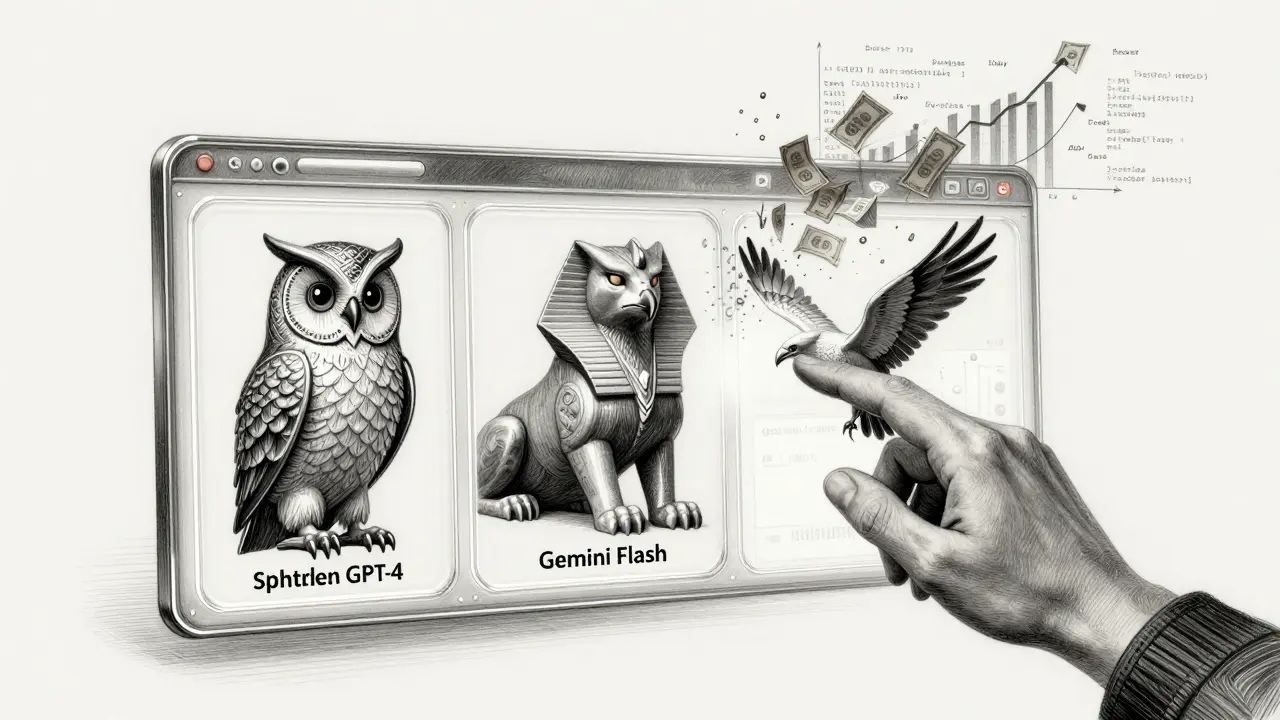
You wouldn’t use a bulldozer to plant tulips. Yet, many developers still use Claude Opus 3.5 to generate a simple login form. That’s like hiring a Formula 1 driver to deliver groceries. It works-but you’re paying $20 per task for something Gemini Flash can do in 5 credits. The AI coding market hit $1.2 billion in late 2025. But here’s the kicker: teams using a single model for everything spent 37% more than those who switched models based on task type. Why? Because each AI has a personality. Claude thinks deeply. GPT-4 plans carefully. Gemini Flash moves fast and cuts fat.Claude Opus 3.5: The Deep Thinker
Claude Opus 3.5, released in October 2025, is the architect of the bunch. It doesn’t just write code-it maps out the system first. In Vooster AI’s tests, it took 14.7 logical steps to design a database schema. GPT-4 did 11.3. Gemini? Just 9.8. That’s why it’s perfect for complex design work. Need a secure, scalable permission system with five interconnected tables? Opus will map every edge case. It scored 87.4% on the HumanEval benchmark-the highest of any model. It also nailed security-sensitive code at 91.2% accuracy in Windsurf’s January 2026 tests. But here’s the catch: it’s slow and expensive. Each complex schema task costs 20 credits. It needs 16GB of RAM to run smoothly locally. And if you ask it to build ten CRUD endpoints? It’ll over-engineer every single one. Developers on Reddit reported wasting $800 and three weeks before switching to Gemini Flash for simple tasks.GPT-4 Turbo: The Balanced Architect
GPT-4 Turbo, updated in November 2024 and now in its 5.2 version, is the middle ground. It’s not the deepest thinker like Opus, but it’s more consistent than Gemini. It handles architectural decisions better than anyone else-89% accuracy on system design tasks, according to GitHub’s Copilot data. It’s the go-to for teams building full-stack apps where structure matters. Need to connect a React frontend to a PostgreSQL backend with proper API routing and error handling? GPT-4 gets it. It’s also the most reliable for long-horizon tasks-those that take more than an hour to build. In Vals AI’s December 2025 benchmark, GPT-5.2 (the latest version) hit 41.31% accuracy on 2+ hour tasks. Claude Sonnet 4.5? 22.62%. Gemini? Less. It’s not cheap-18 credits per complex task-but it’s predictable. And it’s the only model Gartner labeled a “Leader” in architectural design. If you’re building something that has to last five years, GPT-4 is your anchor.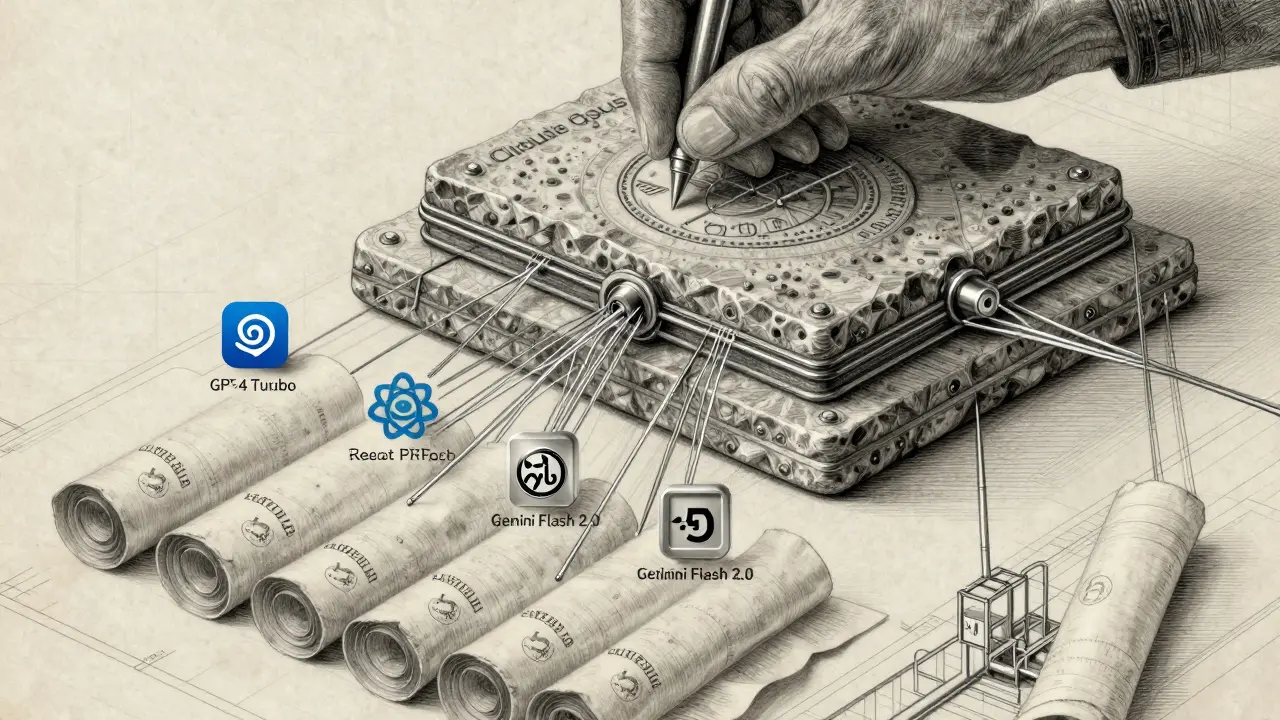
Gemini Flash 2.0: The Speed Demon
Gemini Flash 2.0, released in September 2025, is the anti-complexity model. It doesn’t overthink. It doesn’t add features. It gives you the smallest, fastest version of what you asked for. It crushed other models in generating repetitive code. For CRUD operations-create, read, update, delete-it hit 93.5% accuracy. That’s 8% higher than GPT-4 and 12% higher than Claude Sonnet. It’s also the cheapest: just 5 credits per task. And it’s fast-47% faster than Opus on simple jobs, according to Google’s internal benchmarks. It runs on 8GB of RAM. Perfect for laptops. Perfect for prototyping. Perfect for when you need a basic API endpoint, a form handler, or a simple UI component in under 10 seconds. But don’t ask it to design a security protocol. Or a complex data flow. Or a multi-tenant system. In those cases, it cuts too much. One developer shared on Hacker News: “Gemini reviewed Opus’s database design and said, ‘You only need two tables.’ It was right. Saved us two weeks.” But if you asked Gemini to build that same system from scratch? It might leave out critical auth flows.How to Build a Vibe Coding Workflow
The best teams don’t pick one model. They pick three-and assign roles.- MAX models (Opus, GPT-4): Use for critical design. Database schemas, security layers, API architecture, complex business logic.
- PRO models (Sonnet, GPT-4 mini): Use for planning. Breaking down tasks, writing PRDs, drafting user stories, explaining code.
- FREE models (Gemini Flash): Use for repetition. CRUD, form handlers, boilerplate, UI components, test files.
Real-World Example: Building a SaaS Auth System
Let’s say you’re building a SaaS product with user roles, billing, and OAuth.- Step 1: Design the database. Ask Claude Opus 3.5. It’ll suggest tables for users, roles, permissions, sessions, and audit logs. It’ll flag edge cases like role inheritance and token revocation.
- Step 2: Review with Gemini Flash. Ask Gemini: “Can this be simpler?” It’ll say, “You don’t need audit logs for MVP. Remove them.” You’ll save weeks.
- Step 3: Generate the API endpoints. Use Gemini Flash. It’ll spit out clean, tested Express.js routes in seconds.
- Step 4: Secure the auth flow. Switch to GPT-4. It’ll add rate limiting, JWT validation, and CSRF protection you didn’t even think of.
- Step 5: Verify. Run the final code through two models. If Opus and GPT-4 both agree on the security layer? You’re safe.
What You Need to Learn
This isn’t about coding anymore. It’s about model orchestration. You need to know:- When to use deep thinking vs. fast execution.
- Which model catches what kind of error.
- How to spot when Gemini is oversimplifying or Opus is overcomplicating.
The Future Is Multi-Model
By 2027, Gartner predicts the “one model fits all” approach will vanish. Every professional team will use multiple models. It’s becoming as standard as Git. New models are coming. Claude Opus 4.6 (March 2026) will get better at database optimization. Gemini 2.1 (coming soon) will handle 2 million tokens-perfect for analyzing entire codebases. GPT-5.3 will improve multi-model coordination. The winners won’t be the ones with the smartest AI. They’ll be the ones who know how to use the right AI for the right job.What to Do Today
If you’re still using one model for everything:- Stop using Opus for simple tasks.
- Stop using Gemini for security-critical code.
- Start using GPT-4 for architecture, Opus for deep design, and Gemini Flash for repetition.
- Run critical outputs through two models. Always.
- Track your AI spend. You’ll be shocked how much you’re wasting.
What is vibe coding?
Vibe coding is when developers describe what they want-like “a secure user auth system with roles and sessions”-and let AI generate the actual code. It’s not about typing every line. It’s about directing the AI with clear intent, then reviewing and refining its output. This approach became mainstream in 2025 as models like Claude Opus and GPT-4 Turbo became reliable enough for production work.
Which AI model is best for database design?
Claude Opus 3.5 is the best for complex database design. It excels at reasoning through relationships, edge cases, and scalability. In tests, it processed 14.7 logical steps per schema-more than GPT-4 or Gemini. But for MVPs, always run Opus’s design through Gemini Flash. It often spots over-engineering and suggests simpler structures that save weeks of work.
Is Gemini Flash good enough for production code?
Yes-for the right tasks. Gemini Flash 2.0 is excellent at generating repetitive, low-risk code like CRUD endpoints, form handlers, and UI components. It’s 93.5% accurate on these tasks. But don’t use it for security logic, complex business rules, or system architecture. It cuts too much. Use it as a speed tool, not a thinking tool.
Why is GPT-4 still popular if Opus is smarter?
Because GPT-4 is more balanced. While Opus thinks deeper, GPT-4 is more consistent across different tasks. It’s the best for architectural decisions (89% accuracy) and long-horizon projects. It’s also better at integrating components-like connecting a frontend to a backend with clean APIs. Teams use GPT-4 as the anchor, Opus for deep dives, and Gemini for speed.
How much can I save by switching models?
Teams that switched from using one premium model for everything to a tiered system saved 37% on AI costs. One team cut monthly spending from $1,200 to $450. The savings come from using Gemini Flash for simple tasks (5 credits) instead of Opus (20 credits). When you do 100 simple tasks a month, that’s $1,500 saved per year just on one type of work.
Do I need special tools to use multiple models?
Not strictly, but it helps. Tools like Continue (open-source, Jan 2026) let you switch between Claude, GPT-4, and Gemini inside your code editor without copying text. This reduces context-switching time by 72%. Without tools, you’ll waste hours switching tabs and pasting. For professional teams, automation is no longer optional-it’s the baseline.
What’s the biggest mistake people make with vibe coding?
Using the wrong model for the job. The most common error? Using Claude Opus to generate simple API endpoints. It’s like using a jet engine to power a bicycle. You pay more, wait longer, and get over-engineered code. The fix is simple: use Gemini Flash for repetition, GPT-4 for structure, and Opus only for deep design.


